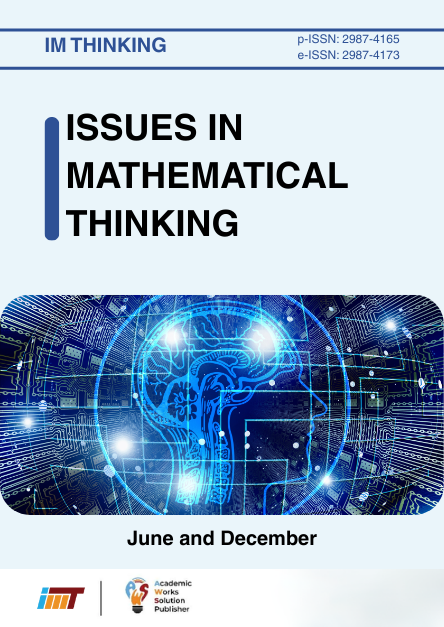
The IM Thinking (Issues in Mathematical Thinking) is an open-access and peer-reviewed International journal that aims to contribute to the enhancement of mathematics education through the publication of high-quality, original research and scholarly articles. It seeks to provide a platform for educators, researchers, policymakers, and practitioners from around the world to exchange ideas and insights related to research on mathematics education at all levels, from primary to higher education. The journal focuses on advancing theoretical, empirical, and practical knowledge in mathematics education, which aims to bridge the gap between research and practice.

The journal publishes scholarly work that focuses exclusively on mathematical thinking. The term ‘mathematical thinking’ should be interpreted broadly as it covers thinking, ability, skills, and competence in the field of mathematics education. This issue includes but is not limited to mathematical literacy, computational thinking, problem-solving skills, mathematical reasoning, mathematical connection, mathematical communication and representation, spatial thinking skills, statistical literacy, and technological mathematical literacy.

The journal welcomes contributions from researchers, educators, and practitioners in the field of mathematics education at all levels of education. The journal accepts a variety of article types, including empirical articles and review articles. Contributors to the journal should ensure that their work is original, unpublished, and not under consideration elsewhere, and aligned with the scope and objectives of the journal.

Journal Information

sampul imt

Title: IM Thinking (Issues In Mathematical Thinking)
Initials: IM Thinking
Abbreviation: IM Thinking
Publications Frequency: Biannually issued (June and December)
DOI: -
ISSN: 2987-4165 (Print)
ISSN: 2987-4173 (Online)
Business Model: Open Access, Author-Pays
Publisher: Academic Works Solution
Indexing: Google Scholar | Dimensions


Editorial Process

Submission to First Decision: 1 week
Submission to Acceptance: 4-12 weeks
Acceptance to Publish: 2 weeks

Before Submission

Authors are required to carefully prepare their manuscripts in accordance with the standards and policies of IM Thinking. Compliance with the journal’s template, focus, scope, and academic writing quality is essential. Manuscripts that do not meet these requirements may be rejected during the initial editorial screening.

Key Requirements:

  1. The manuscript must be prepared using the official IM Thinking template and follow the author guidelines.

  2. Single-author manuscripts are permitted, provided they meet IM Thinking's academic and scientific standards.

  3. The content of the manuscript must be aligned with the focus and scope of IM Thinking.

  4. Authors are responsible for ensuring that their manuscripts are written in clear, coherent, and academically rigorous English.

  5. Manuscripts that do not follow the template, are outside the journal’s scope, or demonstrate poor English quality may be desk rejected.

  6. Only manuscripts that meet IM Thinking standards will be processed for peer review.

  7. Authors are required to register and log in to submit manuscripts online and to monitor the status of their submissions.

Current Issue

Vol. 1 No. 1 (2023)
					View Vol. 1 No. 1 (2023)

Issues in Mathematical Thinking (IM Thinking) is an international journal that concerns primarily on mathematical thinking. IM Thinking journal welcomes varied approaches to empirical research – i.e. qualitative, quantitative, and mixed methods – and also high quality systematic literature reviews and meta-analyses.

Issues in Mathematical Thinking journal is published biannually, namely in June and December by AWS Publisher.

Published: 05/02/2023
View All Issues

About the Journal

Issues in Mathematical Thinking (IM Thinking) is an international journal that concerns primarily on mathematical thinking. The term ‘mathematical thinking’ should be interpreted broadly as it covers thinking, ability, skills, and competence in the field of mathematics education. This issue includes but is not limited to mathematical literacy, computational thinking, problem solving skills, mathematical reasoning, mathematical connection, mathematical communication and representation, spatial thinking skills, statistical literacy, and technological mathematical literacy. IM Thinking journal welcomes varied approaches to empirical research – i.e. qualitative, quantitative, and mixed methods – and also high quality systematic literature reviews and meta-analyses.

Issues in Mathematical Thinking journal is published biannually, namely in June and December.