

Instruction for Authors

Thank you for choosing to submit your manuscript to Issues in Mathematical Thinking (IM Thinking) journal. This ‘instruction for authors’ is provided to ensure your manuscript fulfil the requirement for peer review and publication in IM Thinking journal. Please take the time to read and follow the instruction as closely as possible.

GENERAL REQUIREMENT

The author should consider that the manuscript is in the following condition:

  1. The manuscripts must be original, unpublished, and is not under consideration for publication elsewhere.  

  2. The manuscript is written in English and follows the rules of academic writing and standard grammar.

  3. The author has to make sure that the manuscript has been prepared using the IM Thinking template, following the author guidelines. 

  4. The manuscript should also have been carefully proofread (the proofreading certificate may be required based on the language editor evaluation).

  5. Any manuscript which does not meet the author guidelines, focus and scope, is written in a different format, or has poor soundness of English, will be immediately rejected. 

AUTHORSHIP

  1. The single author's paper is not a consideration for publication in IM Thinking. It is just for the invited author or the author who has a great reputation for research or publication in mathematics education.

  2. The authors listed in an article published in IM Thinking should have made a significant contribution to the work reported. This could be in terms of research conception or design, or acquisition of data, or the analysis and interpretation of data. As an author or co-author, you share responsibility and accountability for the content of your article. Please avoid being a gift (guest) authorship where someone is added to the list of authors who have not been involved in writing the paper or ghost authorship where someone has been involved in writing the paper but is not included in the list of authors.

STRUCTURE OF THE MANUSCRIPT

Starting from 2023, we will implement a new writing structure to satisfy the rigorous standards of international scientific article writing.

  1. Title: The title should describe the contents of the manuscript, with a maximum of 20 words.

  2. Author's identity: The author's name should be accompanied by the author's institutions without the academic title. For a joint paper, one of the authors should be identified as the corresponding author.

  3. Abstract: The abstract should be clear, concise, and descriptive. This abstract should provide a brief introduction to the problem, objective of study, the methodology, and a summary of results. The abstract should end with a comment on the significance of the results or a brief conclusion. Abstract is written in 10pt Calibri and single space, preferably not more than 200 words. Keywords should consist of 3–5 words, with a maximum of five keywords accompanying the abstract.

  4. Introduction: The introduction should provide clear and concise information about the background or motivation to research, the importance of the topics and the current problem (gap analysis). All statements must be supported by the latest reference from journal articles. This section should also provide the relevant research problems and objectives, relevant research hypothesis (if any), and the importance or contribution of the research to the field. This section should also describe the critically analysed literature review from relevant references. Then, the summary of the literature review and its implications for the problem investigated (novelty). The conceptual framework is also suggested to be described in this section. A conceptual framework represents the relationship expected between variables in the study. It is highly recommended to describe the literature review and the conceptual framework in a separate subsection.

  5. Methods: The research methods must provide information about how to solve the research problems. Generally consists of the type and design of the study, the research setting, research subjects (population, sample and sampling), data collection techniques, the validity of the data (if any), and data analysis techniques. 

  6. Findings: The findings present the results of the research in the form of tables, charts, diagrams, or narratives were then given meaning or description of any research results are presented.

  7. Discussion: The discussion contains a description of the researchers on the study results, either as expected or not. Then compare the findings by previous studies that mainly had been published in reputable scientific journals or use the literature. 

  8. Conclusion: The conclusion provides concise information about what was gained from the research that has been done. Then give the implications and a clue to undertake further studies related to the results of the study.

  9. Acknowledgement: Include an acknowledgement if parties have made a significant contribution in funding and/or provided support to the research.
  10. Author's Declaration: This section includes the authors' contribution, funding statement, data availability, and competing interests.

  11. Bibliography: The bibliography contains at least 30 references, with most of them (70%) from reputable international journals (Scopus/WoS database). It is highly recommended to use the latest publication. In addition, references from textbooks should be minimised. The bibliography is written in APA style, 7th edition. The authors should also utilise reference management software, such as Mendeley, to organise the bibliography. The DOI of all references (if any) must be included.

Table

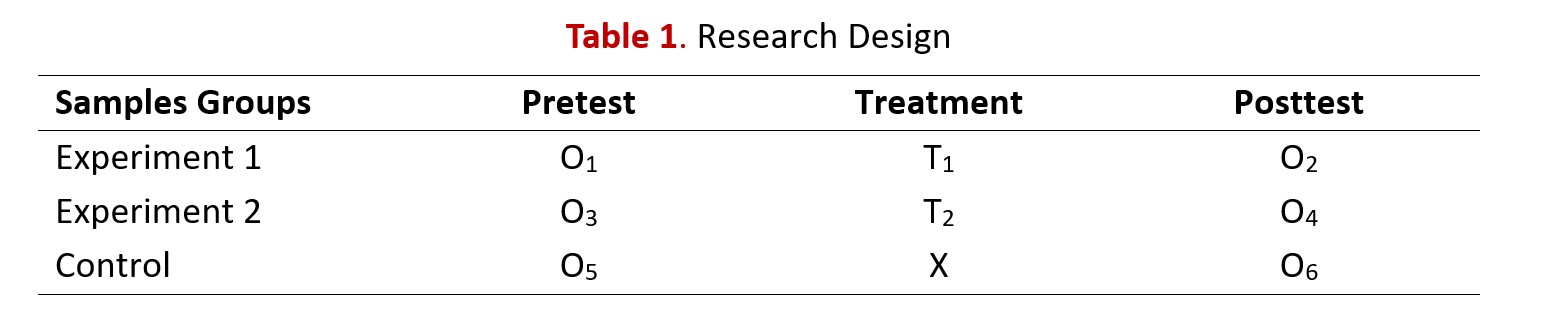
Tables are sequentially numbered with the table title and number above the table. Tables should be centered in the column OR on the page. Tables should be followed by a line space (11pt). Elements of a table should be single-spaced, however double spacing can be used to show groupings of data or to separate parts within the table. Table headings should be at 11pt. Tables are referred to in the text by the table number, e.g. Table 1. Only horizontal lines are allowed to appear in the table. Vertical lines should not be shown.

contoh tabel

Figure

Figures are sequentially numbered, commencing at 1 with the figure title and number below the figure as shown in Figure 1. Detailed recommendations for figures are as follows:

  • Ensure that figures are clear and legible with typed lettering.
  • Black & white or colored figures are allowed.

The submission should be in an appropriate format as follows: BMP, JPG, or PNG

contoh img

Equation

Equations should be numbered serially within parentheses as shown in Equation (1). Equation should be prepared using MS Equation Editor (not in image format). The equation number is to be placed at the extreme right side.