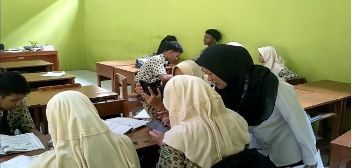
Increasing students’ interest in learning through Discovery Learning assisted by Geogebra and Quizizz
DOI:
https://doi.org/10.66161/708563Keywords:
Learning interest, Geogebra, Quizizz, Discovery LearningAbstract
This study aims to determine whether there is an increase in students' interest in learning mathematics through
the implementation of the Discovery Learning model supported by GeoGebra and Quizizz. The research subjects
were students of class VIII.4 at one of the schools in Tegal City, Indonesia. Data were collected using observation,
questionnaires, and documentation. To assess students' level of interest, observations and questionnaires were
administered before and after the implementation of the learning model. The pre-implementation questionnaire
results showed an average interest level of 43%, with the five indicators distributed as follows: enjoyment (55%),
curiosity (43%), learning activity (35%), initiative (44%), and goal-setting (38%). Post-implementation results
showed an average increase to 50%, with enjoyment (61%), curiosity (47%), learning activity (49%), initiative
(46%), and goal-setting (46%). These findings indicate that the use of Discovery Learning supported by GeoGebra
and Quizizz can enhance students' interest in learning mathematics. This conclusion is further supported by
classroom observations, which revealed that students appeared more focused and enthusiastic during the
learning process.
References
Arbain, N., & Shukor, N. A. (2015). The Effects of GeoGebra on Students Achievement. Procedia - Social and Behavioral Sciences, 172, 208–214. https://doi.org/10.1016/j.sbspro.2015.01.356
Armizah, D. , & R. (2023). Penggunaan media Geogebra dalam meningkatkan minat belajar siswa pada materi geometri ruang. Jurnal Pendidikan Dan Riset Sains, 2(2), 225–234. https://www.semanticscholar.org/reader/bb459c6d2c079dd883a13a6b772913601a80aa73
Batubara, I. H. (2019). Improving Student’s Critical Thinking Ability Through Guided Discovery Learning Methods Assisted by Geogebra. International Journal for Educational and Vocational Studies, 1(2), 116–119. https://doi.org/10.29103/ijevs.v1i2.1371
Dewantara, E. B. , E. D. S. , & W. A. (2022). Implementasi penggunaan Quizizz untuk asesmen peserta didik di SMP Unggulan ‘Aisyiyah Bantul. Prosiding Seminar Nasional Hasil Pelaksanaan Program Pengenalan Lapangan Persekolahan, Universitas Ahmad Dahlan, Yogyakarta, Indonesia.
Dewi, N., Talib, A., & Djam’an, N. (2021). Student Difficulties in Learning Mathematics Based on Learning Styles. International Conference on Educational Studies in Mathematics (ICoESM 2021), 611(1), 11–18. https://doi.org/10.2991/assehr.k.211211.003
García-López, I. M., Acosta-Gonzaga, E., & Ruiz-Ledesma, E. F. (2023). Investigating the Impact of Gamification on Student Motivation, Engagement, and Performance. Education Sciences, 13(8), 813. https://doi.org/10.3390/educsci13080813
Hamidah, Kusuma, J. W., & Auliana, S. (2024). Development of Discovery-Based Etnobra (Ethnomathematics Geogebra) Geometry Learning Model to Improve Geometric Skills in Terms of Student Learning Styles and Domicile. Mathematics Teaching-Research Journal, 16(3), 25–57. https://mtrj.commons.gc.cuny.edu/volume-16-n-3/
Hernawati, K., & Surjono, H. D. (2019). Improving trigonometry learning motivation using Geogebra-Assisted Guided Discovery Student Worksheet (GDSW). Journal of Physics: Conference Series, 1320(1). https://doi.org/10.1088/1742-6596/1320/1/012082
Herpratiwi, H., & Tohir, A. (2022). Learning Interest and Discipline on Learning Motivation. International Journal of Education in Mathematics, Science and Technology, 10(2), 424–435. https://doi.org/10.46328/ijemst.2290
Hill, F., Mammarella, I. C., Devine, A., Caviola, S., Passolunghi, M. C., & Szucs, D. (2016). Maths anxiety in primary and secondary school students: Gender differences, developmental changes and anxiety specificity. Learning and Individual Differences, 48, 45–53. https://doi.org/10.1016/j.lindif.2016.02.006
Ishartono, N., Nurcahyo, A., Waluyo, M., Prayitno, H. J., & Hanifah, M. (2022). Integrating GeoGebra into the flipped learning approach to improve students’ self-regulated learning during the covid-19 pandemic. Journal on Mathematics Education, 13(1), 69–86. https://doi.org/10.22342/jme.v13i1.pp69-86
Ishartono, N., Razak, R. binti A., Kholid, M. N., Arlinwibowo, J., & Afiyah, A. N. (2024). Integrating Steam into Flip Flop Model to Improve Students’ Understanding on Composition of Functions During Online Learning. Infinity Journal, 13(1), 45–60. https://doi.org/10.22460/infinity.v13i1.p45-60
Jäder, J., & Johansson, H. (2025). Exploring students’ conceptual understanding through mathematical problem solving: students’ use of and shift between different representations of rational numbers. Research in Mathematics Education, 1(1), 1–18. https://doi.org/10.1080/14794802.2025.2456840
Kamid, K., Rohati, R., Hobri, H., Triani, E., Rohana, S., & Pratama, W. A. (2022). Process Skill and Student’s Interest for Mathematics Learning: Playing a Traditional Games. International Journal of Instruction, 15(3), 967–988. https://doi.org/10.29333/iji.2022.15352a
KÜÇÜK, K., & GÜN, Ö. (2023). The Effects of GeoGebra-Assisted Transformation Geometry Instruction on Student Achievement, Attitudes, and Beliefs. Journal of Computer and Education Research, 11(22), 671–690. https://doi.org/10.18009/jcer.1324668
Lestari, E. S. (2022). Model Pembelajaran Konstruktivis Metakognitif untuk Meningkatkan Kemampuan Berpikir Kritis. Jurnal Basicedu, 6(2), 2647–2653. https://doi.org/10.31004/basicedu.v6i2.2469
Muchuweni, T., Jojo, Z., & Kariyana, I. (2025). Enhancing Mathematics Instruction through Quizizz: A Systematic Literature Review. International Journal of Learning, Teaching and Educational Research, 24(10), 106–124. https://doi.org/10.26803/ijlter.24.10.5
Murni, V., Sariyasa, S., & Ardana, I. M. (2017). GeoGebra Assist Discovery Learning Model for Problem Solving Ability and Attitude toward Mathematics. Journal of Physics: Conference Series, 895, 012049. https://doi.org/10.1088/1742-6596/895/1/012049
Nadhiroh, S., & Anshori, I. (2023). Implementasi Kurikulum Merdeka Belajar dalam Pengembangan Kemampuan Berpikir Kritis pada Pembelajaran Pendidikan Agama Islam. Fitrah: Journal of Islamic Education, 4(1), 56–68. https://doi.org/10.53802/fitrah.v4i1.292
Nugroho, H., Ishartono, N., Agustiani, R., & Fitriani, N. (2024). Integrating Adobe Flash Professional CS6 into ethnomathematics-based learning media to improve students’ understanding of math. The 7th Progressive and Fun Education International Conference, 1–20. https://doi.org/10.1063/5.0183038
Nugroho, H., & Septianisha, N. I. (2025). Improving Students’ Mathematical Representation Skills in Systems of Linear Equations in Two Variables Through Geogebra-Based STEM Approaches: A Quasi-Experimental Study. Jurnal Pendidikan Matematika Dan IPA, 16(1), 67–81. https://doi.org/10.26418/jpmipa.v16i1.78553
Putriani, D., & Rahayu, C. (2018). The Effect of Discovery Learning Model Using Sunflowers in Circles on Mathematics Learning Outcomes. International Journal of Trends in Mathematics Education Research, 1(1), 22–25. https://doi.org/10.33122/ijtmer.v1i1.26
Renninger, K. A., & Hidi, S. E. (2019). The Cambridge Handbook of Motivation and Learning. Cambridge University Press. https://doi.org/10.1017/9781316823279
Sahari, E., & Ayunis, A. (2024). Enhancing Students’ Motivation and Learning Outcomes in Thematic Learning Using the Discovery Learning Model for Grade V SDN 31 Kinali. TOFEDU: The Future of Education Journal, 3(1), 638–647. https://doi.org/10.61445/tofedu.v3i1.137
Saifiyah, S., & Retnawati, H. (2019). Why is Mathematical Representation Difficult for Students? Journal of Physics: Conference Series, 1397(1). https://doi.org/10.1088/1742-6596/1397/1/012093
Sarifah, I., Rohmaniar, A., Marini, A., Sagita, J., Nuraini, S., Safitri, D., Maksum, A., Suntari, Y., & Sudrajat, A. (2022). Development of Android Based Educational Games to Enhance Elementary School Student Interests in Learning Mathematics. International Journal of Interactive Mobile Technologies, 16(18), 149–161. https://doi.org/10.3991/ijim.v16i18.32949
Schoenfeld, A. H. (2022). Why Are Learning and Teaching Mathematics So Difficult? In Handbook of Cognitive Mathematics (pp. 763–797). Springer International Publishing. https://doi.org/10.1007/978-3-031-03945-4_10
Setiyani, S., Fitriyani, N., & Sagita, L. (2020). Improving student’s mathematical problem solving skills through Quizizz. JRAMathEdu (Journal of Research and Advances in Mathematics Education), 5(3), 276–288. https://doi.org/10.23917/jramathedu.v5i3.10696
Setyaningrum, W., & Waryanto, N. H. (2018). Developing mathematics edutainment media for Android based on students’ understanding and interest: A teachers’ review. Journal of Physics: Conference Series, 983(1). https://doi.org/10.1088/1742-6596/983/1/012093
Subekti, M. A. S., & Prahmana, R. C. I. (2021). Developing interactive electronic student worksheets through discovery learning and critical thinking skills during pandemic era. Mathematics Teaching-Research Journal, 13(2), 137–174. https://files.eric.ed.gov/fulltext/EJ1383140.pdf
Sugiyono. (2022). Metode Penelitian Kuantitatif, Kualitatif, dan R&D. Alfabeta.
Suhada, S., Sunardi, S., Amali, L. N., Katili, M. R., Lahinta, A., & Kilo, J. R. (2024). Using Discovery Learning and Problem-Based Learning to Increase Students’ Motivation for Accomplishment. Elinvo (Electronics, Informatics, and Vocational Education), 8(2), 255–263. https://doi.org/10.21831/elinvo.v8i2.58612
Uwurukundo, M. S., Maniraho, J. F., & Tusiime Rwibasira, M. (2022). Effect of GeoGebra Software on Secondary School Students’ Achievement in 3-D Geometry. Education and Information Technologies, 27(4), 5749–5765. https://doi.org/10.1007/s10639-021-10852-1
Wijaya, T. T., Rahmadi, I. F., Chotimah, S., Jailani, J., & Wutsqa, D. U. (2022). A Case Study of Factors That Affect Secondary School Mathematics Achievement: Teacher-Parent Support, Stress Levels, and Students’ Well-Being. International Journal of Environmental Research and Public Health, 19(23), 16247. https://doi.org/10.3390/ijerph192316247
Yerizon, Fatimah, S., & Tasman, F. (2021). Development of a geogebra-assisted calculus worksheet to enhance students’ understanding. International Journal of Information and Education Technology, 11(10), 456–463. https://doi.org/10.18178/ijiet.2021.11.10.1550
Zhang, Y., Wang, P., Jia, W., Zhang, A., & Chen, G. (2025). Dynamic visualization by GeoGebra for mathematics learning: a meta-analysis of 20 years of research. Journal of Research on Technology in Education, 57(2), 437–458. https://doi.org/10.1080/15391523.2023.2250886
Ziatdinov, R., & Valles, J. R. (2022). Synthesis of Modeling, Visualization, and Programming in GeoGebra as an Effective Approach for Teaching and Learning STEM Topics. Mathematics, 10(3). https://doi.org/10.3390/math10030398