Improving vocational high school students’ mathematics achievement by integrating Differentiated Instruction through Nearpod
DOI:
https://doi.org/10.66161/708476Keywords:
Differentiated Learning, Gamification, Learning Outcomes, Learning Readiness, NearpodAbstract
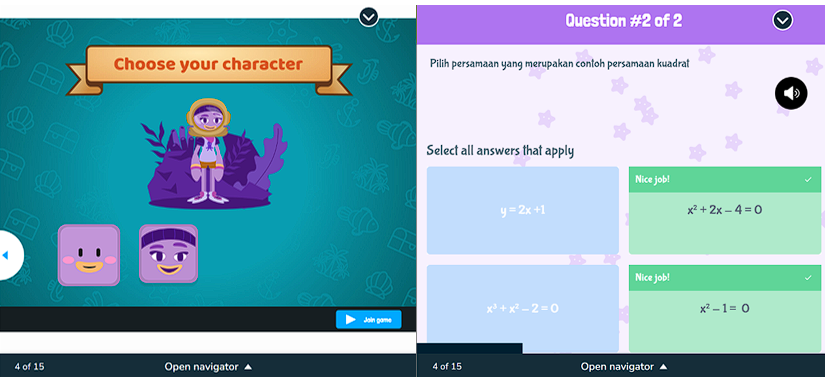
Education is one of the key aspects that can determine whether a nation advances or not. However, Indonesian students’ learning outcomes in numeracy indicators are still relatively low. Teachers need to prepare new learning strategies and create a learning atmosphere that is enjoyable, creative, and skill oriented. This study aims to describe the effect of integrating differentiated learning through Nearpod on vocational high school students' learning outcomes. The method used is a quasi-experimental design with a pre-experimental one-group pretest-posttest approach. The population consisted of 2,027 students, and the sample included 35 students selected using purposive sampling. Data analysis techniques employed the Independent Sample T-Test. The results showed that the integration of differentiated learning through Nearpod had a significant effect on the learning outcomes of vocational high school students. There was an increase in the average posttest scores of students after receiving mathematics instruction using differentiated learning supported by the gamified Nearpod application. These findings support the importance of integrating differentiated learning through Nearpod to improve student learning outcomes and build quality education
References
Abdul Rahman, M. H., Ismail Yusuf Panessai, I., Mohd Noor, N. A. Z., & Mat Salleh, N. S. (2018). Gamification Elements and Their Impacts on Teaching and Learning – a Review. The International Journal of Multimedia & Its Applications, 10(06), 37–46. https://doi.org/10.5121/ijma.2018.10604
Al-Shehri, M. S. (2020). Effect of Differentiated Instruction on the Achievement and Development of Critical Thinking Skills among Sixth-Grade Science Students. International Journal of Learning, Teaching and Educational Research, 19(10), 77–99. https://doi.org/10.26803/ijlter.19.10.5
Aningsih, Zulela, M. S., Neolaka, A., Iasha, V., & Setiawan, B. (2022). How is the Education Character Implemented? The Case Study in Indonesian Elementary School. Journal of Educational and Social Research, 12(1), 371–380. https://doi.org/10.36941/jesr-2022-0029
Ariyanti, F., & Rahayu, W. P. (2025). Development of Nearpod-Based Learning Evaluation to Measure Students’ Critical Thinking Skills in Retail Business Management Subjects (Case Study in Class XI of the Department of Online Business and Marketing SMKN 1 Jombang) (pp. 62–80). https://doi.org/10.2991/978-94-6463-722-9_7
Clark, A., Ornella, W., & Mike, R. (2020). Teaching with digital technology. ZDM, 52(7), 1223–1242. https://doi.org/10.1007/s11858-020-01196-0
DEMİR, S. (2021). Effects of learning style based differentiated activities on gifted students’ creativity. Journal for the Education of Gifted Young Scientists, 9(1), 47–56. https://doi.org/10.17478/jegys.754104
Elizabeth Freire Espin, S., & Marcelo Rodriguez Cortez, D. (2022). Nearpod as a Gamification Resource for Teaching in Virtual Education: a Mathematical Case Study. 2022 International Conference on Inventive Computation Technologies (ICICT), 177–183. https://doi.org/10.1109/ICICT54344.2022.9850488
Hernandez-Mena, C., Amado-Moranchel, N., Avalos, M. O., Alvarez, J., & Faccinetto-Beltrán, P. (2024). Improving Student Motivation in Higher Education Through Nearpod. 2024 IEEE Global Engineering Education Conference (EDUCON), 1–4. https://doi.org/10.1109/EDUCON60312.2024.10578581
Hudson, B. (2007). Comparing different traditions of teaching and learning: What can we learn about teaching and learning? European Educational Research Journal, 6(2), 135–146. https://doi.org/10.2304/eerj.2007.6.2.135
Ishartono, N., Halili, S. H. B., & Razak, R. B. A. (2024). A systematic literature review of the implementation of open education: in the Indonesian context. International Journal of Innovation and Learning, 36(1), 98–116. https://doi.org/10.1504/IJIL.2024.139704
Kirschner, F., Paas, F., Kirschner, P. A., & Janssen, J. (2011). Differential effects of problem-solving demands on individual and collaborative learning outcomes. Learning and Instruction, 21, 587e599. https://doi.org/10.1016/j.learninstruc.2011.01.001
Kummanee, J., Nilsook, P., & Wannapiroon, P. (2020). Digital learning ecosystem involving steam gamification for a vocational innovator. International Journal of Information and Education Technology, 10(7), 533–539. https://doi.org/10.18178/ijiet.2020.10.7.1420
Kusmaharti, D., & Yustitia, V. (2022). Self-regulated learning-based digital module development to improve students’ critical thinking skills. Al-Jabar : Jurnal Pendidikan Matematika, 13(1), 211–220. https://doi.org/10.24042/ajpm.v13i1.12756
Lee & Johnston. (2024). The mediating effect of growth mindset on differentiated counseling services and numeracy achievement. Educational Researcher, 53(2), 97–109. https://doi.org/https://doi.org/10.3102/0013189X231234567
Mohamad et al. (2024). Differentiated guidance services in improving numeracy skills among secondary school students. Journal of Counseling and Development, 102(1), 112–129. https://doi.org/https://doi.org/10.1002/jcad.12487
Muangsrinoon, S., & Boonbrahm, P. (2019). Game elements from literature review of gamification in healthcare context. Journal of Technology and Science Education, 9(1), 20–31. https://doi.org/10.3926/jotse.556
Net, W. W. W. P., & Kusmaryono, I. (2023). How are Critical Thinking Skills Related to Students’ Self-Regulation and Independent Learning? Pegem Journal of Education and Instruction, 13(4), 85–92. https://doi.org/10.47750/pegegog.13.04.10
Nugroho, H. (2024). Pendekatan stem berbantuan geogebra pada materi SPLDV untuk meningkatkan representasi matematis. Jurnal Ilmiah WUNY, 6(1). https://doi.org/10.21831/jwuny.v6i1.72275
Nugroho, H., Desti, D., Kismiantini, K., & Setyaningrum, L. (2025). Integrating GeoGebra into Project-Based Learning to Improve Students ’ Problem-Solving Skill on Circle Topic. Proceedings of the 8th International Symposium on Mathematics Education and Innovation (ISMEI 2024), 35–54. https://doi.org/10.2991/978-2-38476-434-1
Nugroho, H., Ishartono, N., Agustiani, R., & Fitriani, N. (2024). Integrating Adobe Flash Professional CS6 into ethnomathematics-based learning media to improve students’ understanding of math. The 7th Progressive and Fun Education International Conference, 1–20. https://doi.org/10.1063/5.0183038
Nugroho, H., & Septianisha, N. I. (2025). Improving Students’ Mathematical Representation Skills in Systems of Linear Equations in Two Variables Through Geogebra-Based STEM Approaches: A Quasi-Experimental Study. Jurnal Pendidikan Matematika Dan IPA, 16(1), 67–81. https://doi.org/10.26418/jpmipa.v16i1.78553
Nugroho, H., Sugiman, S., & Kismiantini, K. (2025). Mathematics-Anxiety and Self-Efficacy of Junior High School Students: Is There a Gender Gap? Southeast Asian Mathematics Education Journal, 15(1), 1–16. https://doi.org/10.46517/seamej.v15i1.440
Olive, J., Makar, K., Hoyos, V., Kor, L. K., Kosheleva, O., & Sträßer, R. (2009). Mathematical Knowledge and Practices Resulting from Access to Digital Technologies. Mathematics Education and Technology-Rethinking the Terrain, 13, 133–177. https://doi.org/10.1007/978-1-4419-0146-0_8
Pujiastuti, E., Sugiman, S., & Pambudi, M. (2025). Promoting Mathematics Problem-Solving Ability in Gamification Integration Using Augmented Reality. European Journal of Educational Research, 14(2), 645–660. https://doi.org/10.12973/eu-jer.14.2.645
Purwitaningrum, R., & Prahmana, R. C. I. (2021). Developing instructional materials on mathematics logical thinking through the Indonesian realistic mathematics education approach. International Journal of Education and Learning, 3(1), 13–19. https://doi.org/10.31763/ijele.v3i1.178
Retnawati, H. (2016). Analisis Kuantitatif Instrumen Penelitian (Panduan Peneliti, Mahasiswa, dan Psikometrian). Parama publishing.
Schunk, D. H. (2012). Learning Theories An Educational Perspective. Pearson.
Sembiring, R. K., Hadi, S., & Dolk, M. (2008). Reforming mathematics learning in Indonesian classrooms through RME. ZDM - International Journal on Mathematics Education, 40(6), 927–939. https://doi.org/10.1007/s11858-008-0125-9
Sinha, T., Kapur, M., West, R., Catasta, M., Hauswirth, M., & Trninic, D. (2021). Differential benefits of explicit failure-driven and success-driven scaffolding in problem-solving prior to instruction. Journal of Educational Psychology, 113(3), 530–555. https://doi.org/10.1037/edu0000483
Sirakaya, M., & Kilic Cakmak, E. (2018). Effects of Augmented Reality on Student Achievement and Self-Efficacy in Vocational Education and Training. International Journal for Research in Vocational Education and Training, 5(1), 1–18. https://doi.org/10.13152/IJRVET.5.1.1
Tomlinson, C. A. (2014). The Differentiated Classroom: Responding to the Needs of All Learners. ASCD: Alexandria.
Ulfah, S., Akmalia, R., & Jusra, H. (2023). Gender differences in mathematics anxiety and learning motivation of students during the COVID-19. Jurnal Elemen, 9(1), 256–270. https://doi.org/10.29408/jel.v9i1.6971
Wijaya, T. T., Hidayat, W., Hermita, N., Alim, J. A., & Talib, C. A. (2024). Exploring Contributing Factors To Pisa 2022 Mathematics Achievement: Insights From Indonesian Teachers. Infinity Journal, 13(1), 139–156. https://doi.org/10.22460/infinity.v13i1.p139-156
Wilkie, K. J., & Ayalon, M. (2018). Investigating Years 7 to 12 students’ knowledge of linear relationships through different contexts and representations. Mathematics Education Research Journal, 30, 499–523. https://doi.org/10.1007/s13394-018-0236-8
Downloads
Published
How to Cite
Issue
Section
License
Copyright (c) 2025 Instructional Media for Mathematics (IM Math)

This work is licensed under a Creative Commons Attribution-NonCommercial 4.0 International License.