The effectiveness of problem-based learning (PBL) in improving mathematical conceptual understanding and numeracy of grade VIII students
DOI:
https://doi.org/10.66161/708562Keywords:
Problem-Based Learning, mathematical conceptual understanding, Numeracy, junior high schoolAbstract
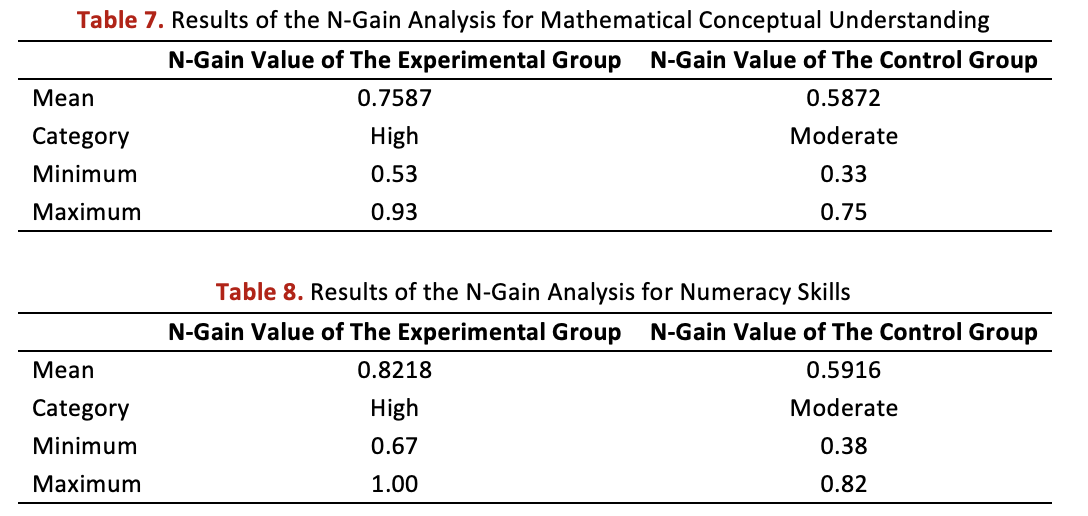
This study aims to examine the effectiveness of the Problem-Based Learning (PBL) model in improving students’ mathematical conceptual understanding and numeracy skills at the junior high school level. This research employed a quantitative approach using a quasi-experimental design with a pretest–posttest control group design. The participants consisted of two Grade VIII classes of SMP Negeri 2 Bambanglipuro, with 32 students in each class. The experimental group was taught using the PBL model, while the control group received expository learning. Data were collected through validated and reliable tests of mathematical conceptual understanding and numeracy. Data analysis included the Independent Samples t-test, One-Sample Z Test, One-Sample Proportion Z Test, and N-Gain analysis. The results showed that students in the PBL class achieved an average posttest score equal to or higher than the Minimum Mastery Criterion (MMC = 75) with a mastery proportion of 75%. The N-Gain scores for mathematical conceptual understanding and numeracy were 0.7587 and 0.8218, respectively, which fall into the high category. These findings indicate that the PBL model is effective in enhancing students’ mathematical conceptual understanding and numeracy skills.
References
Aba‐Oli, Z., Koyas, K., & Husen, A. (2025). Higher‐order thinking skills‐oriented problem‐based learning interventions in mathematics: A systematic literature review. School Science and Mathematics, 125(3), 214–231. https://doi.org/10.1111/ssm.12676
Ahdhianto, E., Marsigit, M., Haryanto, H., & Nurfauzi, Y. (2020). Improving Fifth-Grade Students’ Mathematical Problem-Solving and Critical Thinking Skills Using Problem-Based Learning. Universal Journal of Educational Research, 8(5), 2012–2021. https://doi.org/10.13189/ujer.2020.080539
Apit Dulyapit, Yayat Supriatna, & Fanny Sumirat. (2023). Application of the Problem Based Learning (PBL) Model to Improve Student Learning Outcomes in Class V at UPTD SD Negeri Tapos 5, Depok City. Journal of Insan Mulia Education, 1(1), 31–37. https://doi.org/10.59923/joinme.v1i1.10
Arbo, J. B., & Ching, D. A. (2022). Problem-Based Learning Approach in Developing Mathematical Skills. International Journal of Science, Technology, Engineering and Mathematics, 2(1). https://doi.org/10.53378/352873
Boye, E. S., & Agyei, D. D. (2023). Effectiveness of problem-based learning strategy in improving teaching and learning of mathematics for pre-service teachers in Ghana. Social Sciences & Humanities Open, 7(1), 100453. https://doi.org/10.1016/j.ssaho.2023.100453
Chen, O., Retnowati, E., & Kalyuga, S. (2020). Element interactivity as a factor influencing the effectiveness of worked example–problem solving and problem solving–worked example sequences. British Journal of Educational Psychology, 90(S1), 210–223. https://doi.org/10.1111/bjep.12317
Darma, I. K., Candiasa, I. M., Sadia, I. W., & Dantes, N. (2018). The effect of problem based learning model and authentic assessment on mathematical problem solving ability by using numeric ability as the covariable. Journal of Physics: Conference Series, 1040, 012035. https://doi.org/10.1088/1742-6596/1040/1/012035
Dorimana, A., Uworwabayeho, A., & Nizeyimana, G. (2022). Enhancing Upper Secondary Learners’ Problem-solving Abilities using Problem-based Learning in Mathematics. International Journal of Learning, Teaching and Educational Research, 21(8), 235–252. https://doi.org/10.26803/ijlter.21.8.14
Ennis, R. H. (1987). Critical thinking and the curriculum. Thinking skills instruction: Concepts and techniques. Springer.
Eviliasani, K., Sabandar, J., & Fitriani, N. (2022). Problem-Based Learning Assisted by GeoGebra to Improve Students’ Mathematical Understanding. AL-ISHLAH: Jurnal Pendidikan, 14(1), 85–98. https://doi.org/10.35445/alishlah.v14i1.1092
Ghozali, I. (2016). Aplikasi analisis multivariate dengan program IBM SPSS. Badan Penerbit Universitas Diponegoro.
Hidayat, W. (2017). Konsep dasar pembelajaran matematika. Refika Aditama.
Hung, C. M., Hwang, G. J., & Huang, I. (2012). A project-based digital storytelling approach for improving students’ learning motivation, problem-solving competence and learning achievement. Educational Technology and Society, 15(4), 368–379. https://www.jstor.org/stable/jeductechsoci.15.4.368
Marchy, F., Murni, A., Kartini, K., & Muhammad, I. (2022). The Effectiveness of Using Problem-Based Learning (PBL) in Mathematics Problem-Solving Ability for Junior High School Students. AlphaMath : Journal of Mathematics Education, 8(2), 185. https://doi.org/10.30595/alphamath.v8i2.15047
Mary, & Anastasia. (2013). Supporting Student Self-Regulated Learning in Problem- and Project-Based Learning. Interdisciplinary Journal of Problem-Based Learning, 7(2), 127–150. http://10.0.30.91/1541-5015.1339%5Cnhttp://search.ebscohost.com/login.aspx?direct=true&db=eue&AN=90663292&%5Cnlang=ko&site=ehost-live
Masitoh, L. F., & Fitriyani, H. (2018). Improving students’ mathematics self-efficacy through problem based learning. Malikussaleh Journal of Mathematics Learning (MJML), 1(1), 26. https://doi.org/10.29103/mjml.v1i1.679
Nugroho, H., Desti, D., Kismiantini, K., & Setyaningrum, L. (2025). Integrating GeoGebra into Project-Based Learning to Improve Students ’ Problem-Solving Skill on Circle Topic. Proceedings of the 8th International Symposium on Mathematics Education and Innovation (ISMEI 2024), 35–54. https://doi.org/10.2991/978-2-38476-434-1
Nugroho, H., & Septianisha, N. I. (2025). Improving Students’ Mathematical Representation Skills in Systems of Linear Equations in Two Variables Through Geogebra-Based STEM Approaches: A Quasi-Experimental Study. Jurnal Pendidikan Matematika Dan IPA, 16(1), 67–81. https://doi.org/10.26418/jpmipa.v16i1.78553
Patmara, R., Wahyudin, A., & Susilaningsih, E. (2020). Implementation of Problem-Based Learning Model with Ethnomathematics Nuance Towards Students’ Problem-Solving Ability and Mathematics Anxiety. Journal of Primary Education, 9(2), 188–196. https://journal.unnes.ac.id/sju/index.php/jpe/article/view/31350
Patunah, S., Herman, T., & Hasanah, A. (2024). The Enhancement of Mathematical Problem-Solving Skills among Junior High School Students Using Problem-based Learning. Jurnal Pendidikan MIPA, 25(3), 1067–1079. https://doi.org/10.23960/jpmipa/v25i3.pp1067-1079
Peterson, A. (2020). Character education, the individual and the political. Journal of Moral Education, 49(2), 143–157. https://doi.org/10.1080/03057240.2019.1653270
Purwanti, D., Zaenuri, , & Asikin, M. (2021). Problem Solving Ability in the Learning Model of Problem-Based Learning based on Ethnomathematics. Journal of Primary Education, 10(1), 113–120. https://journal.unnes.ac.id/sju/index.php/jpe/article/view/34303
Rahmadi, J., Wahyu, Y., & Oktari, V. (2024). Implementation of creative problem-solving model with RME approach on mathematics problem-solving ability. Jurnal Elemen, 10(1), 43–54. https://doi.org/10.29408/jel.v10i1.19788
Ramadhani, R., Farid, F., Lestari, F., & Machmud, A. (2020). Improvement of Creative Thinking Ability through Problem-Based Learning with Local Culture Based on Students’ Gender and Prior Mathematics Ability. Al-Jabar : Jurnal Pendidikan Matematika, 11(1), 61–72. https://doi.org/10.24042/ajpm.v11i1.4961
Rehman, N., Zhang, W., Mahmood, A., Fareed, M. Z., & Batool, S. (2023). Fostering twenty-first century skills among primary school students through math project-based learning. Humanities and Social Sciences Communications, 10(1), 424. https://doi.org/10.1057/s41599-023-01914-5
Santrock, J. (2009). Educational Psychology. Jakarta: Salemba Humanika.
Sugiyono. (2018). Metode penelitian pendidikan: Pendekatan kuantitatif, kualitatif, dan R&D. Alfabeta.
Suparman, S., Yohannes, Y., & Arifin, N. (2021). Enhancing Mathematical Problem-Solving Skills of Indonesian Junior High School Students through Problem-Based Learning: a Systematic Review and Meta-Analysis. Al-Jabar : Jurnal Pendidikan Matematika, 12(1), 1–16. https://doi.org/10.24042/ajpm.v12i1.8036
Suratno, J., & Waliyanti, I. K. (2023). The Integration of GeoGebra in Problem-Based Learning to Improve Students’ Problem-Solving Skills. International Journal of Research in Mathematics Education, 1(1), 63–75. https://doi.org/10.24090/ijrme.v1i1.8514
Tursynkulova, E., Madiyarov, N., Sultanbek, T., & Duysebayeva, P. (2023). The effect of problem-based learning on cognitive skills in solving geometric construction problems: a case study in Kazakhstan. Frontiers in Education, 8. https://doi.org/10.3389/feduc.2023.1284305
Ulya, H., Sugiman, Rosnawati, R., & Retnawati, H. (2024). Technology-based learning interventions on mathematical problem-solving: a meta-analysis of research in Indonesia. International Journal of Evaluation and Research in Education , 13(1), 292–301. https://doi.org/10.11591/ijere.v13i1.26380
Yazar Soyadı, B. B. (2015). Creative and Critical Thinking Skills in Problem-based Learning Environments. Journal of Gifted Education and Creativity, 2(2), 71–71. https://doi.org/10.18200/jgedc.2015214253
Yuhana, Y., & Fajari, L. E. W. (2025). Cross-disciplinary effects of problem-based learning on problem-solving skills in mathematics and beyond: A comprehensive meta-analysis and bibliometric. Eurasia Journal of Mathematics, Science and Technology Education, 21(11), em2732. https://doi.org/10.29333/ejmste/17345
Zaenuri, Imam, F., & Nugroho, S. E. (2020). The effectiveness of problem based learning (PBL) model with ethnomatematics to improve mathematics literation ability of high school students. Journal of Physics: Conference Series, 1567(2), 022086. https://doi.org/10.1088/1742-6596/1567/2/022086
Zamir, S., Yang, Z., Wenwu, H., & Sarwar, U. (2022). Assessing the attitude and problem-based learning in mathematics through PLS-SEM modeling. PLOS ONE, 17(5), e0266363. https://doi.org/10.1371/journal.pone.0266363
Zhang, F., Wang, H., Bai, Y., & Zhang, H. (2022). A Bibliometric Analysis of the Landscape of Problem-Based Learning Research (1981–2021). Frontiers in Psychology, 13. https://doi.org/10.3389/fpsyg.2022.828390