Development of RPG educational game Mathvestor for vocational high school mathematics learning
DOI:
https://doi.org/10.66161/708479Keywords:
CTL, Compound Interest, Educational Game, Problem-solving, PolyaAbstract
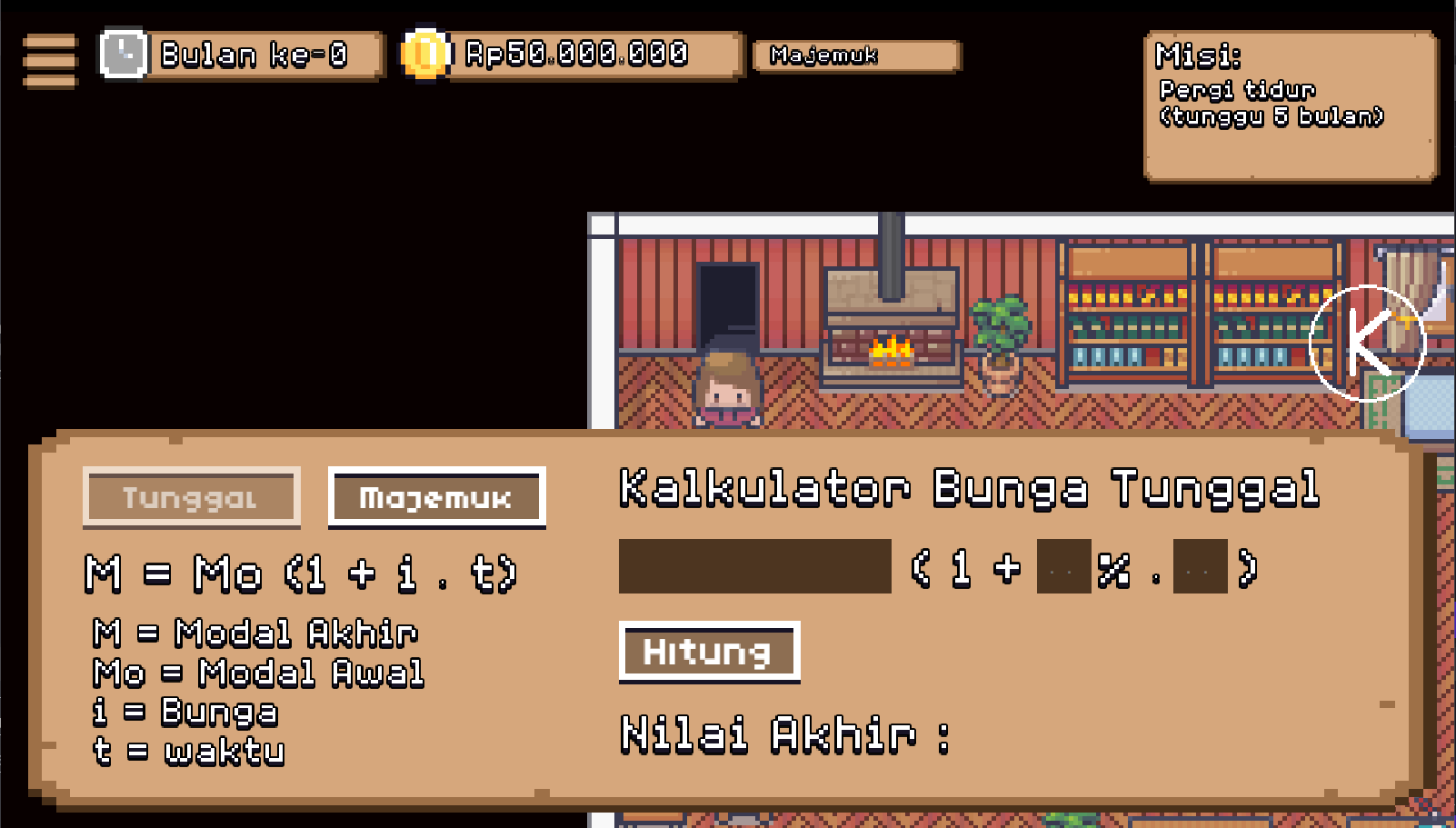
Problem-solving ability is a key competency in mathematics education, yet studies indicate that this skill remains low among vocational high school students. This study aims to develop and evaluate the feasibility of an educational RPG game, “Mathvestor,” designed using the Contextual Teaching and Learning (CTL) approach and Polya’s problem-solving stages for teaching simple and compound interest. The research employed an R&D method using the ADDIE model. Media validity was assessed by material and media experts, while practicality was evaluated through student questionnaires, teacher responses, and classroom implementation observations. The validation results indicated a “very valid” category, with scores of 94% for material and 91% for media. Practicality tests also showed a “very practical” category based on student responses (88%), teacher responses (94%), and implementation observations (88.8%). These findings demonstrate that Mathvestor is feasible and effective as an interactive and contextual learning medium to support students’ mathematical problem-solving skills.
References
Andriyani. (2023). Stimulation of Cognitive and Psychomotor Capability by Game-Based Learning with Computational Thinking Core. Mathematics Teaching-Research Journal, 15(5), 76–104. https://mtrj.commons.gc.cuny.edu/volume-15-n-5/
Arikunto, S. (2013). Prosedur Penelitian: Suatu Pendekatan Praktik [Research Procedures: A Practical Approach]. Bumi Aksara.
Asnawi, M. H., Annisa, H., Ulum, Moh. M., Arofah, N. L., & Hendrawati, N. E. (2022). Ethnomathematic Exploration At Agung Jami’ Malang Mosque In Improving Students’ Mathematic Problem Solving Ability. IndoMath: Indonesia Mathematics Education, 5(1), 13. https://doi.org/10.30738/indomath.v5i1.13
Chiu, F.-Y., & Hsieh, M.-L. (2017). Role-Playing Game Based Assessment to Fractional Concept in Second Grade Mathematics. EURASIA Journal of Mathematics, Science and Technology Education, 13(4), 1–15. https://doi.org/10.12973/eurasia.2017.00659a
Dia, I. O., Putra, Z. H., Witri, G., Dahnilsyah, & Aljarrah, A. (2024). Development of a Traditional Game-Based Computational Thinking Supplementary Textbook for Elementary School Students. Mathematics Teaching-Research Journal, 16(2), 185–206. https://mtrj.commons.gc.cuny.edu/volume-16-n2/
Fernández-Oliveras, A., Espigares-Gámez, M. J., & Oliveras, M. L. (2021). Implementation of a playful microproject based on traditional games for working on mathematical and scientific content. Education Sciences, 11(10). https://doi.org/10.3390/educsci11100624
Hoogland, K., de Koning, J., Bakker, A., Pepin, B. E. U., & Gravemeijer, K. (2018). Changing representation in contextual mathematical problems from descriptive to depictive: The effect on students’ performance. Studies in Educational Evaluation, 58(April), 122–131. https://doi.org/10.1016/j.stueduc.2018.06.004
Indah Wulandari, S., Widiyatmoko, A., & Dwi Wulandari, T. (2025). Development of E-Module Based on Game-Based Learning to Enhance Students’ Conceptual Understanding and Interest in Vibration and Wave Concept. Journal of Educational Technology Development and Exchange, 18(4), 117–139. https://doi.org/10.18785/jetde.1804.06
Ngurah, A., Cintyawati, T., & Suniasih, N. W. (2024). Contextual-based Open-Ended Model Improves Numeracy Skills of Grade IV Elementary School Students. Thinking Skills and Creativity Journal, 7(1), 175–181. https://doi.org/10.23887/tscj.v7i1.78228
Nieveen, N. (1999). Prototyping to Reach Product Quality. In Design Approaches and Tools in Education and Training (pp. 125–135). Springer Netherlands. https://doi.org/10.1007/978-94-011-4255-7_10
Nugroho, H., Arliana, E., & Sugiman, S. (2026). Integrating Realistic Mathematics Education Approach into Instructional Websites to Improve Students’ Computational Thinking Skills in Mathematics. Mathematics Teaching-Research Journal, 18(1), 178–233. http://files.commons.gc.cuny.edu.s3.amazonaws.com/wp-content/blogs.dir/34462/files/2026/03/007_Nugroho-Arliani-and-Sugiman-18no1.pdf
Nugroho, H., Desti, D., Kismiantini, K., & Setyaningrum, L. (2025). Integrating GeoGebra into Project-Based Learning to Improve Students ’ Problem-Solving Skill on Circle Topic. Proceedings of the 8th International Symposium on Mathematics Education and Innovation (ISMEI 2024), 35–54. https://doi.org/10.2991/978-2-38476-434-1
Nurhayati, R., Waluya, S. B., Sri, T., & Asih, N. (2021). Development of Web-Based Interactive Learning Multimedia with Contextual Approach to Facilitate Mathematical Critical Thinking Ability. Unnes Journal of Mathematics Education Research, 12(1), 50–57. https://journal.unnes.ac.id/sju/ujmer/article/view/44459
Nursyahidah, F., Saputro, B. A., & Rubowo, M. R. (2018). A Secondary Student’s Problem Solving Ability in Learning Based on Realistic Mathematics with Ethnomathematics. JRAMathEdu (Journal of Research and Advances in Mathematics Education), 3(1), 13. https://doi.org/10.23917/jramathedu.v3i1.5607
OECD. (2003). The PISA 2003 Assessment Framework: Mathematics, Reading, Science and Problem Solving Knowledge and Skills. OECD.
Polya, G. (1977). Mathematical methods in science. Cambridge University Press. https://doi.org/10.5948/UPO9780883859414
Rahmadi, J., Wahyu, Y., & Oktari, V. (2024). Implementation of creative problem-solving model with RME approach on mathematics problem-solving ability. Jurnal Elemen, 10(1), 43–54. https://doi.org/10.29408/jel.v10i1.19788
Ramadhani, R., Syahputra, E., & Simamora, E. (2023). Ethnomathematics approach integrated flipped classroom model: Culturally contextualized meaningful learning and flexibility. Jurnal Elemen, 9(2), 371–387. https://doi.org/10.29408/jel.v9i2.7871
Reyes, J. D., Insorio, A. O., Ingreso, M. L. V, Hilario, F. F., & Gutierrez, C. R. (2019). Conception and Application of Contextualization in Mathematics Education. International Journal of Education Studies in Mathematics, 6(1), 1–18. https://dergipark.org.tr/en/pub/ijesim/issue/43715/454218
Samo, D. D., Darhim, & Kartasasmita, B. G. (2018). Culture-based contextual learning to increase problem-solving ability of first year university student. Journal on Mathematics Education, 9(1), 81–93. https://doi.org/10.22342/jme.9.1.4125.81-94
Simamora, R. E., Saragih, S., & Hasratuddin, H. (2018). Improving Students’ Mathematical Problem Solving Ability and Self-Efficacy through Guided Discovery Learning in Local Culture Context. International Electronic Journal of Mathematics Education, 14(1), 61–72. https://doi.org/10.12973/iejme/3966
Sugiyono. (2016). Metode Penelitian Kualitatif, Kuantitatif dan R&D. Alfabeta.
Suryawati, E., & Osman, K. (2018). Contextual learning: Innovative approach towards the development of students’ scientific attitude and natural science performance. Eurasia Journal of Mathematics, Science and Technology Education, 14(1), 61–76. https://doi.org/10.12973/ejmste/79329
Van Oers, B. (1998). From context to contextualizing. Learning and Instruction, 8(6), 473–488. https://doi.org/10.1016/S0959-4752(98)00031-0
Wahyuni, R., Juniati, D., & Wijayanti, P. (2024). How do Math Anxiety and Self-Confidence Affect Mathematical Problem Solving? TEM Journal, 13(1), 550–560. https://doi.org/10.18421/TEM131-58
Wang, S.-Y., Chang, S.-C., Hwang, G.-J., & Chen, P.-Y. (2018). A microworld-based role-playing game development approach to engaging students in interactive, enjoyable, and effective mathematics learning. Interactive Learning Environments, 26(3), 411–423. https://doi.org/10.1080/10494820.2017.1337038
Wijaya, A., Van den Heuvel-Panhuizen, M., Doorman, M., & Veldhuis, M. (2018). Opportunity-to-learn to solve context-based mathematics tasks and students’ performance in solving these tasks - Lessons from Indonesia. Eurasia Journal of Mathematics, Science and Technology Education, 14(10). https://doi.org/10.29333/ejmste/93420
Downloads
Published
How to Cite
Issue
Section
License
Copyright (c) 2025 Instructional Media for Mathematics (IM Math)

This work is licensed under a Creative Commons Attribution-NonCommercial 4.0 International License.