PythaMath: Interactive mathematics learning media based on problem-based learning oriented to the numeracy ability of grade VIII students
DOI:
https://doi.org/10.66161/708468Keywords:
Numeracy skill, Problem-Based LearningAbstract
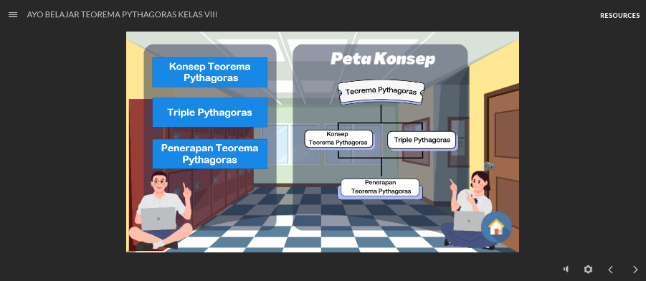
This study aims to develop and test the validity, practicality, and effectiveness of interactive learning media 'PythaMath' based on Problem Based Learning (PBL) on the Pythagorean theorem material that is oriented towards the numeracy skills of grade VIII students. The method used in this study is Research and Development (R&D) with the ADDIE development model (Analysis, Design, Development, Implementation, and evaluation). The subjects of this study were grade VIII students of SMP Negeri 2 Salaman. The results of the validity test showed that 'PythaMath' was in the "good" category, the practicality test showed a very positive student response with the "very good" category, and the effectiveness test showed that this interactive learning media was effective for use in learning seen from the significance of the posttest of the control class and the experimental class which showed that the significance value was less than 0.05. The interactive mathematics learning media 'PythaMath' is also able to provide a more active and independent learning experience and its ease of access offline. This study concludes that the interactive learning media ‘PythaMath’ is suitable for use to support the mathematics learning process in classes that are oriented towards the numeracy skills of junior high school students.
References
Abdullah, A. A., Richardo, R., Rochmadi, T., Wijaya, A., & Nurkhamid, N. (2022). The Use of Ethnomathematics Learning Media Based on Augmented Reality for Madrasah Students. AL-ISHLAH: Jurnal Pendidikan, 14(1), 877–886. https://doi.org/10.35445/alishlah.v14i1.1140
Ade, I. P., Payadnya, A., Wibawa, K. A., Agung, I. G., & Trisna, N. (2024). How do Indonesian students respond to ethnomathematics-based learning in the digital era ? Indonesian Journal of Science and Mathematics Education, 07(November), 545–560. https://doi.org/10.24042/ijsme.v5i1.21548
Andari, S., I Made Suarjana, & I Nyoman Laba Jayanta. (2024). Development of Ethnomathematics-Based Educational Game Media to Improve Metacognitive Abilities and Learning Motivation in the Material of Flat Area of Grade V Elementary School. MIMBAR PGSD Undiksha, 12(3), 554–563. https://doi.org/10.23887/jjpgsd.v12i3.92131
Astuti, E. P., Wijaya, A., & Hanum, F. (2024). Characteristics of junior high school teachers’ beliefs in developing students’ numeracy skills through ethnomathematics-based numeracy learning. Journal of Pedagogical Research, 8(1), 244–268. https://doi.org/10.33902/JPR.202423405
Baharun, H., Muali, C., & Minarti, S. (2020). Effectiveness of Android-Based Mathematics Learning Media Application on Student Learning Achievement Effectiveness of Android-Based Mathematics Learning Media Application on Student Learning Achievement. Journal of Physics: Conference Series, 1594. https://doi.org/10.1088/1742-6596/1594/1/012047
Boadu, S. K., & Boateng, F. O. (2024). Enhancing students’ achievement in mathematics education in the 21st century through technology integration, collaborative learning, and student motivation: The mediating role of student interest. Eurasia Journal of Mathematics, Science and Technology Education, 20(11). https://doi.org/10.29333/ejmste/15622
Cahyanindya, B. A., & Mampouw, H. L. (2020). Pengembangan Media Puppy Berbasis Adobe Flash CS6 Untuk Pembelajaran Teorema Pythagoras. Jurnal Cendekia : Jurnal Pendidikan Matematika, 4(1), 396–405. https://doi.org/10.31004/cendekia.v4i1.233
Choirudin, C., Ningsih, E. F., Amrulloh, H., Anwar, M. S., Azizah, I. N., & Prastika, M. S. (2020). Development of Learning Media for Ethnomathematics and Culture of Lampung with the Powtoon Application. Jurnal Tadris Matematika, 3(2), 141–152. https://doi.org/10.21274/jtm.2020.3.2.141-152
Damayanti, I. I., Ayu, A., Sariah, U. I., Mustaqfiroh, M., Oktaviani, I. A., & Nursyahidah, F. (2023). Development of Curved Three-Dimensional Shape Learning Media Ethnomathematics-Based Using Augmented Reality. Kreano, Jurnal Matematika Kreatif-Inovatif, 14(1), 86–96. https://doi.org/10.1063/5.0215290
Darmayanti, R., Sugianto, R., Baiduri, B., Choirudin, C., & Wawan, W. (2022). Digital comic learning media based on character values on students’ critical thinking in solving mathematical problems in terms of learning styles. Al-Jabar : Jurnal Pendidikan Matematika, 13(1), 49–66. https://doi.org/10.24042/ajpm.v13i1.11680
Geiger, V., Goos, M., & Dole, S. (2015). The Role of Digital Technologies in Numeracy Teaching and Learning. International Journal of Science and Mathematics Education, 13(5), 1115–1137. https://doi.org/10.1007/s10763-014-9530-4
Guntur, M. I. S., & Setyaningrum, W. (2021). The Effectiveness of Augmented Reality in Learning Vector to Improve Students’ Spatial and Problem-Solving Skills. International Journal of Interactive Mobile Technologies, 15(5), 159–173. https://doi.org/10.3991/ijim.v15i05.19037
Irawan, A., Rahayu, W., & Nuzulah, R. (2023). Design and build of android-based mathematics learning media with traditional game ethnomathematics approach. AIP Conference Proceedings, 2734(1). https://doi.org/10.1063/5.0156445
Ishartono, N., Razak, R. binti A., Kholid, M. N., Arlinwibowo, J., & Afiyah, A. N. (2024). Integrating Steam into Flip Flop Model to Improve Students’ Understanding on Composition of Functions During Online Learning. Infinity Journal, 13(1), 45–60. https://doi.org/10.22460/infinity.v13i1.p45-60
Lestari, R., Prahmana, R. C. I., Chong, M. S. F., & Shahrill, M. (2023). Developing Realistic Mathematics Education-Based Worksheets for Improving Students’ Critical Thinking Skills. Infinity Journal, 12(1), 69–84. https://doi.org/10.22460/infinity.v12i1.p69-84
Mabruri, H., Ahmadi, F., & Suminar, T. (2019). The Development of Science Mobile Learning Media to Improve Primary Students Learning Achievements. Journal of Primary Education, 8(1), 108–116. https://journal.unnes.ac.id/sju/index.php/jpe/article/view/25391
Mellawaty, & Taufan, M. (2021). LMS-Google Classroom Digital Platform: Impact on the Critical Thinking Ability, Self-Concept, and Mathematics Anxiety of Pre-Service Mathematics Teachers during the Covid-19 Pandemic in Indramayu, Indonesia. Journal of Physics: Conference Series, 1783(1). https://doi.org/10.1088/1742-6596/1783/1/012126
Molenda. (2003). In search of the ellusive ADDIE model. Pervormance improvement.
Nieveen, N. (1999). Prototyping to Reach Product Quality. In Design Approaches and Tools in Education and Training (pp. 125–135). Kluwer Academik Publisher. https://doi.org/10.1007/978-94-011-4255-7_10
Ningsih, F., Handayani, W., & Erita, S. (2021). Visual Media-Assisted Problem-Based Learning Model: Does It Affect Students’ Mathematical Critical Thinking Skills? Tarbawi : Jurnal Ilmu Pendidikan, 17(2), 184–192. https://doi.org/10.32939/tarbawi.v17i2.1139
Nugroho, H., Ishartono, N., Agustiani, R., & Fitriani, N. (2024). Integrating Adobe Flash Professional CS6 into ethnomathematics-based learning media to improve students’ understanding of math. The 7th Progressive and Fun Education International Conference, 1–20. https://doi.org/10.1063/5.0183038
OECD. (2023). PISA 2022 Results (Volume I and II) - Country Notes: Indonesia.
Patmara, R., Wahyudin, A., & Susilaningsih, E. (2020). Implementation of Problem-Based Learning Model with Ethnomathematics Nuance Towards Students’ Problem-Solving Ability and Mathematics Anxiety. Journal of Primary Education, 9(2), 188–196. https://journal.unnes.ac.id/sju/index.php/jpe/article/view/31350
Puspitarini, Y. D., & Hanif, M. (2019). Using Learning Media to Increase Learning Motivation in Elementary School. Anatolian Journal of Education, 4(2), 53–60. https://doi.org/10.29333/aje.2019.426a
Rangkuti, A. N., & Siregar, A. I. (2020). Lintasan Belajar Teorema Pythagoras dengan Pendekatan Pendidikan Matematika Realistik. Logaritma : Jurnal Ilmu-Ilmu Pendidikan Dan Sains, 7(02), 149–162. https://doi.org/10.24952/logaritma.v7i02.2112
Shutaleva, A., Martyushev, N., Nikonova, Z., Savchenko, I., Kukartsev, V., Tynchenko, V., & Tynchenko, Y. (2023). Sustainability of Inclusive Education in Schools and Higher Education: Teachers and Students with Special Educational Needs. Sustainability, 15(4), 3011. https://doi.org/10.3390/su15043011
Suendarti, M., Liberna, H., Lestari, W., Masruroh, A., & Lisgianto, A. (2022). Development of Android-Based Mathematics Learning Media on Three-Dimensional Geometry for Vocational High Schools with an Ethnomathematical Approach. Turkish Journal of Computer and Mathematics Education, 13(2), 140–150. https://doi.org/10.17762/turcomat.v13i03.12895
Suratno, J., & Waliyanti, I. K. (2023). The Integration of GeoGebra in Problem-Based Learning to Improve Students’ Problem-Solving Skills. International Journal of Research in Mathematics Education, 1(1), 63–75. https://doi.org/10.24090/ijrme.v1i1.8514
Suripah, & Susanti, W. D. (2022). Alternative Learning During a Pandemic: Use of the Website As a Mathematics Learning Media for Student Motivation. Infinity Journal, 11(1), 17–32. https://doi.org/10.22460/infinity.v11i1.p17-32
Tanjung, F. R., & Widodo, S. (2024). Metricfy: Aplikasi Pembelajaran Numerasi berbasis Web. Edumatic: Jurnal Pendidikan Informatika, 8(1), 242–251. https://doi.org/10.29408/edumatic.v8i1.25757
Triton, P. B. (2006). SPSS 13.0 terapan riset statistik parametrik. Andi Offset.
Widoyoko, E. P. (2012). Evaluasi Program Pembelajaran: Panduan Praktis Bagi Pendidik dan Calon Pendidik (cetakan ke). Pustaka Belajar.
Wijaya, A. (2023). Kemampuan numerasi dan Growth Mindset siswa SMP dan Madrasah Tsanawiyah di Kabupaten Purworejo. Jurnal Riset Pendidikan Matematika, 10(2), 153–164. https://doi.org/10.21831/jrpm.v10i2.66831
Downloads
Published
How to Cite
Issue
Section
License
Copyright (c) 2024 Instructional Media for Mathematics (IM Math)

This work is licensed under a Creative Commons Attribution-NonCommercial 4.0 International License.