The effect of the problem-based learning model with cooperative setting of numbered heads together on students' numeracy skills
DOI:
https://doi.org/10.66161/687841Keywords:
Expository, Numbered Heads Together, Numeracy, Problem-Based LearningAbstract
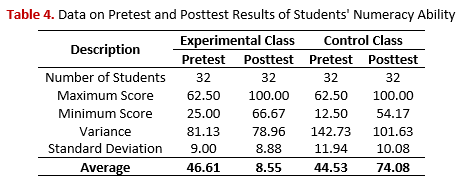
This study aims to: (1) test the effect of the Problem-Based Learning (PBL) model with the cooperative setting of Numbered Heads Together on junior high school students' numeracy skills; (2) test the effect of the expository learning model on statistics material regarding students' numeracy skills; and (3) compare the effectiveness of the PBL model with Numbered Heads Together and the expository model on students' numeracy skills. This quasi-experimental research employs a pretest-posttest control group design and was conducted at a junior high school in Yogyakarta. Data collection techniques included tests and observations, utilizing numeracy skill tests and observation sheets for learning implementation. Data analysis was performed using the Paired Sample T-Test and the Independent Sample T-Test. The findings indicate that (1) the PBL model with the cooperative setting of Numbered Heads Together positively affects students' numeracy skills; (2) the expository learning model on statistics material also enhances numeracy skills; and (3) the PBL model with Numbered Heads Together has a greater impact than the expository model on students' numeracy skills in statistics.
References
Astuti, E. P., Wijaya, A., & Hanum, F. (2024). Characteristics of junior high school teachers’ beliefs in developing students’ numeracy skills through ethnomathematics-based numeracy learning. Journal of Pedagogical Research, 8(1), 244–268. https://doi.org/10.33902/JPR.202423405
Ayuwanti, I., Marsigit, & Siswoyo, D. (2021). Teacher-student interaction in mathematics learning. International Journal of Evaluation and Research in Education, 10(2), 660–667. https://doi.org/10.11591/ijere.v10i2.21184
Bramantha, H. (2021). Perbedaan Kemampuan Berpikir Kritis Siswa Menggunakan Model Pembelajaran Ekspositori Dengan Model Pembelajaran Inquiry Berbantuan Media Video. Education Journal : Journal Educational Research and Development, 5(2), 195–202. https://doi.org/10.31537/ej.v5i2.515
Dhayanti, D., Johar, R., & Zubainur, C. M. (2018). Improving Students’ Critical and Creative Thinking through Realistic Mathematics Education using Geometer’s Sketchpad. JRAMathEdu (Journal of Research and Advances in Mathematics Education), 3(1), 25–35. https://doi.org/10.23917/jramathedu.v3i1.5618
Díez-Palomar, J., Ramis-Salas, M., Močnik, I., Simonič, M., & Hoogland, K. (2023). Challenges for numeracy awareness in the 21st century: making visible the invisible. Frontiers in Education, 8(November), 1–14. https://doi.org/10.3389/feduc.2023.1295781
Fajriah, N., & Asiskawati, E. (2016). Kemampuan Berpikir Kreatif Siswa dalam Pembelajaran Matematika Menggunakan Pendekatan Pendidikan Matematika Realistik di SMP. EDU-MAT Jurnal Pendidikan Matematika, 3(22), 1–23.
Fisher, A., & Scriven, M. (2001). Critical thinking. Cambridge University.
Goos et al. (2019). Numeracy Across the Curriculum: Research-Based Strategies for Enhancing Teaching and Learning. Routledge.
Ishartono, N., Nurcahyo, A., Waluyo, M., Prayitno, H. J., & Hanifah, M. (2022). Integrating GeoGebra into the flipped learning approach to improve students’ self-regulated learning during the covid-19 pandemic. Journal on Mathematics Education, 13(1), 69–86. https://doi.org/10.22342/jme.v13i1.pp69-86
Ishartono, N., Razak, R. binti A., Kholid, M. N., Arlinwibowo, J., & Afiyah, A. N. (2024). Integrating Steam into Flip Flop Model to Improve Students’ Understanding on Composition of Functions During Online Learning. Infinity Journal, 13(1), 45–60. https://doi.org/10.22460/infinity.v13i1.p45-60
Kusaeri, K., Dwisanti, C., Yanti, A., & Ridho, A. (2022). Indonesian Madrasah Competency Assessment: Students’ numeracy based on age. Beta: Jurnal Tadris Matematika, 15(2), 148–156. https://doi.org/10.20414/betajtm.v15i2.558
Kusumaningtias, A., Zubaidah, S., & Indriwati, S. E. (2013). Pengaruh Problem Based Learning dipadu Strategi Numbered Heads Together terhadap Kemampuan Metakognitif, Berpikir Kritis, dan Kognitif Biologi Siswa Kelas XI SMA Negeri 5 Malang. (TESIS). Jurnal Penelitian Kependidikan, 3(January), 33–47.
Lee & Johnston. (2024). The mediating effect of growth mindset on differentiated counseling services and numeracy achievement. Educational Researcher, 53(2), 97–109. https://doi.org/https://doi.org/10.3102/0013189X231234567
Lestari, R., Prahmana, R. C. I., Chong, M. S. F., & Shahrill, M. (2023). Developing Realistic Mathematics Education-Based Worksheets for Improving Students’ Critical Thinking Skills. Infinity Journal, 12(1), 69–84. https://doi.org/10.22460/infinity.v12i1.p69-84
Masliah, L., Nirmala, S. D., & Sugilar, S. (2023). Keefektifan Model Pembelajaran Problem Based Learning ( PBL ) terhadap Kemampuan Literasi dan Numerasi Peserta Didik di Sekolah Dasar. Jurnal Basicedu, 7(1), 1–10. https://doi.org/10.31004/basicedu.v7i1.4106
Maulana, G., Zaenuri, & Junaedi, I. (2020). Pattern of Problem Solving Skill Reviewed Based on Student Cognitive Style After Experienced Problem Based Learning Model with Ethnomathematics Nuances. Journal of Primary Education, 9(2), 209–2019. https://journal.unnes.ac.id/sju/jpe/article/view/37507
Milaturrahmah, N., Mardiyana, & Pramudya, I. (2017). Science, technology, engineering, mathematics (STEM) as mathematics learning approach in 21st century. AIP Conference Proceedings, 1868. https://doi.org/10.1063/1.4995151
Minda, R., Anwar Hadi FS, C., & Jaenudin, J. (2021). Penerapan Model PBL Menggunakan NHT untuk Meningkatkan Kemampuan Pemecahan Masalah dan Minat Belajar Siswa. Jurnal Pendidikan Matematika Dan Sains, 9(1), 19–26. https://doi.org/10.21831/jpms.v9i1.26783
Nasoha, S. R., Araiku, J., Pratiwi, W. D., & Yusup, M. (2022). Kemampuan Numerasi Siswa Melalui Implementasi Bahan Ajar Matematika Berbasis Problem Based Learning. Indiktika : Jurnal Inovasi Pendidikan Matematika, 4(2), 49–61. https://doi.org/10.31851/indiktika.v4i2.7903
Navela, R. A., Kristanto, Y. D., & Partini. (2023). Upaya Meningkatkan Pemahaman Konsep Dan Self Regulated Learning Peserta Didik Melalui Pbl Dipadukan Dengan Nht. Jurnal Pendidikan Matematika Mat-Edukasia, 8(1), 9–18.
Noorhidayati, Nisa, K., & Hardiansyah. (2018). Penerapan Kombinasi Model Pembelajaran PBL dan NHT untuk Meningkatkan Aktivitas dan Hasil Belajar Siswa pada Konsep Fungi. QUANTUM: Jurnal Inovasi Pendidikan Sains, IX(2), 144–149.
Novikasari, I. (2017). Uji Validitas Instrumen. Seminar Nasional Riset Inovatif 2017, 1(1), 530–535.
Nugroho, H., Ishartono, N., Agustiani, R., & Fitriani, N. (2024). Integrating Adobe Flash Professional CS6 into ethnomathematics-based learning media to improve students’ understanding of math. The 7th Progressive and Fun Education International Conference, 1–20. https://doi.org/10.1063/5.0183038
Nurlaily, V. A., Soegiyanto, H., & Usodo, B. (2019). Elementary school teacher’s obstacles in the implementation of problem-based learning model in mathematics learning. Journal on Mathematics Education, 10(2), 229–238. https://doi.org/10.22342/jme.10.2.5386.229-238
OECD. (2023). PISA 2022 Results (Volume I and II) - Country Notes: Indonesia.
Phungsuk, R., Viriyavejakul, C., & Ratanaolarn, T. (2017). Development of a problem-based learning model via a virtual learning environment. Kasetsart Journal of Social Sciences, 38(3), 297–306. https://doi.org/10.1016/j.kjss.2017.01.001
Pusmendik. (2022). Framework Asesmen KompetensI Minimum (AKM). Badan Penelitian dan Pengembangan dan Perbukuan.
Rahmawati, E., & Gusmania, Y. (2017). Pengaruh Model Pembelajaran Kooperatif Tipe Numbered Head Together (Nht) Terhadap Pemahaman Konsep Matematis Siswa Kelas Viii Smp Negeri 53 Batam. PYTHAGORAS: Jurnal Program Studi Pendidikan Matematika, 6(2), 151–160. https://doi.org/10.33373/pythagoras.v6i2.942
Ramadhani, R., Farid, F., Lestari, F., & Machmud, A. (2020). Improvement of Creative Thinking Ability through Problem-Based Learning with Local Culture Based on Students’ Gender and Prior Mathematics Ability. Al-Jabar : Jurnal Pendidikan Matematika, 11(1), 61–72. https://doi.org/10.24042/ajpm.v11i1.4961
Risdiyanti, I., & Prahmana, R. C. I. (2021). Designing Learning Trajectory of Set Through the Indonesian Shadow Puppets and Mahabharata Stories. Infinity Journal, 10(2), 331–348. https://doi.org/10.22460/infinity.v10i2.p331-348
Setyaningsih, N., & Utami, D. P. (2021). The implementation of the discovery model based on numbered head together reviewed from students’ cognitive style in mathematics learning. Journal of Physics: Conference Series, 1722(1). https://doi.org/10.1088/1742-6596/1722/1/012109
Ulya, H., Sugiman, Rosnawati, R., & Retnawati, H. (2024). Technology-based learning interventions on mathematical problem-solving: a meta-analysis of research in Indonesia. International Journal of Evaluation and Research in Education , 13(1), 292–301. https://doi.org/10.11591/ijere.v13i1.26380
Wahyuni, D., & Septiati, E. (2024). Pengaruh Model PBL (Problem Based Learning) Terhadap Kemampuan Literasi Numerasi Peserta Didik SMP Melalui Soal Cerita. Jurnal Cendekia : Jurnal Pendidikan Matematika, 8(2), 1579–1589. https://doi.org/10.31004/cendekia.v8i2.2721
Wijaya, A., & Doorman, M. (2021). A Learning Trajectory for Probability: A Case of Game-Based Learning. Journal on Mathematics Education, 12(1), 1–16. https://doi.org/10.22342/jme.12.1.12836.1-16
Zetriuslita, & Ariawan, R. (2021). Students’ Mathematical Thinking Skill Viewed From Curiosity Through Problem-Based Learning Model on Integral Calculus. Infinity Journal, 10(1), 31–40. https://doi.org/10.22460/infinity.v10i1.p31-40
Downloads
Published
How to Cite
Issue
Section
License
Copyright (c) 2024 Instructional Media for Mathematics (IM Math)

This work is licensed under a Creative Commons Attribution-NonCommercial 4.0 International License.