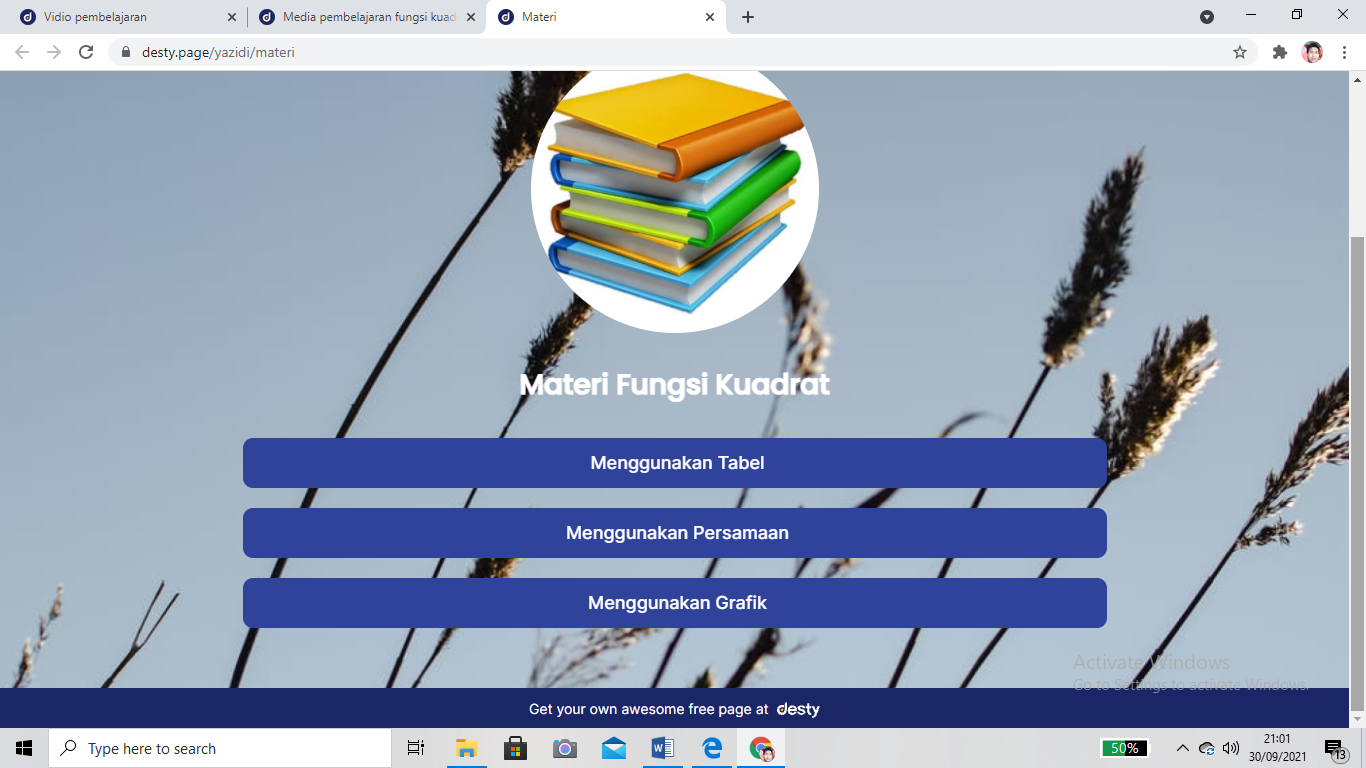
Development of learning media using Desty assisted by Desmos web quadratic function material grade 9 junior high school
DOI:
https://doi.org/10.66161/708373Keywords:
Desty, Junior High School, Learning Media, Quadratic Function, Web DesmosAbstract
The background of this research is the need for more interactive and visual learning media to help students understand abstract concepts, such as quadratic functions, which are often difficult to understand with conventional media. This research aims to develop technology-based mathematics learning media using the Desty platform assisted by Web Desmos on quadratic function material for grade 9 junior high school students. The method used in this research is Research and Development (R&D). The development of learning media was carried out through Thiagarajan's 4D model which consists of defining, designing, developing, and dissemination stages. This study only covers up to the development stage, where validation was conducted by experts without field trials due to restrictions caused by the COVID-19 pandemic. The results showed that the media developed were valid and feasible to use for learning, with the average validation results being in the valid category. The use of this media is expected to improve students' understanding of quadratic function material through clearer and interactive visualization.
References
Amalia, F., & Hadi, S. (2023). Pengelolaan Eling Sebagai Bentuk Inovasi Dalam Menunjang Pembelajaran Bagi Mahasiswa Pada Departemen Sistem Informasi Universitas Brawijaya (Studi Kasus: Program Studi Pendidikan Teknologi Informasi). Jurnal Teknologi Informasi Dan Ilmu Komputer, 10(3), 633–640. https://doi.org/10.25126/jtiik.20231036874
Arikarani & Amirudin. (2021). Pemanfaatan Media dan Teknologi Digital dalam Mengatasi Masalah Pembelajaran di Masa Pandemi. Pharmacognosy Magazine, 75(17), 399–405. https://doi.org/https://doi.org/10.37092/ej.v4i1.296
Asigigan, S. I., & Samur, Y. (2021). The effect of gamified stem practices on students’ intrinsic motivation, critical thinking disposition levels, and perception of problem-solving skills. International Journal of Education in Mathematics, Science and Technology, 9(2), 332–352. https://doi.org/10.46328/IJEMST.1157
Cholily, Y. M., Hasanah, S. N., Effendi, Moh. M., & Putri, O. R. U. (2021). Literasi Digital Siswa Dalam Pembelajaran Matematika Berbantuan Media Space Geometry Flipbook (Sgf). AKSIOMA: Jurnal Program Studi Pendidikan Matematika, 10(3), 1736. https://doi.org/10.24127/ajpm.v10i3.3898
Dikkartin Ovez, F. T. (2018). The Impact of Instructing Quadratic Functions with the Use of Geogebra Software on Students’ Achievement and Level of Reaching Acquisitions. International Education Studies, 11(7), 1. https://doi.org/10.5539/ies.v11n7p1
Dürlinger, F., & Pietschnig, J. (2022). Meta-analyzing intelligence and religiosity associations: Evidence from the multiverse. PLoS ONE, 17(2 February), 1–28. https://doi.org/10.1371/journal.pone.0262699
Flores-Cáceres, R., Dávila-Ignacio, C., Ortega-Galicio, O., Morales-Romero, G., Trinidad-Loli, N., Caycho-Salas, B., Auqui-Ramos, E., León-Velarde, C., & Auqui-Ramos, R. (2022). Evaluation of the learning management system and its relationship in the perception of engineering students. International Journal of Evaluation and Research in Education, 11(4), 1760–1768. https://doi.org/10.11591/ijere.v11i4.22696
Haleem, A., Javaid, M., Qadri, M. A., & Suman, R. (2022). Understanding the role of digital technologies in education: A review. Sustainable Operations and Computers, 3, 275–285. https://doi.org/10.1016/j.susoc.2022.05.004
Hodiyanto, H., Darma, Y., & Putra, S. R. S. (2020). Pengembangan Media Pembelajaran Berbasis Macromedia Flash Bermuatan Problem Posing terhadap Kemampuan Pemecahan Masalah Matematis. Mosharafa: Jurnal Pendidikan Matematika, 9(2), 323–334. https://doi.org/10.31980/mosharafa.v9i2.652
Hokanson, B., & Gibbons, A. (2016). Educational Communications and Technology: Issues and Innovations Design in Educational Technology. In Design in Educational Technology. Springer.
Indariani, A., Amami Pramuditya, S., & Firmasari, S. (2018). Pengembangan Bahan Ajar Digital Berbasis Kemampuan Pemecahan Masalah Matematis pada Pembelajaran Matematika. Eduma : Mathematics Education Learning and Teaching, 7(2), 89–98. https://doi.org/10.24235/eduma.v7i2.3670
Isroil, A., Khairul Umam, A., & Supriyanto, S. (2022). Aplikasi Desmos Dalam Penyelesaian Masalah Persamaan Trigonometri. Karangan: Jurnal Bidang Kependidikan, Pembelajaran, Dan Pengembangan, 4(1), 58–63. https://doi.org/10.55273/karangan.v4i1.171
Kimianti, F., & Prasetyo, Z. K. (2019). Pengembangan E-Modul Ipa Berbasis Problem Based Learning Untuk Meningkatkan Literasi Sains Siswa. Kwangsan: Jurnal Teknologi Pendidikan, 7(2), 91. https://doi.org/10.31800/jtp.kw.v7n2.p91--103
Kurniawan, H. D., & Kuswanto, H. (2021). Improving Students’ Mathematical Representation and Critical Thinking Abilities Using the CAKA Media Based on Local Wisdom. International Journal of Interactive Mobile Technologies, 15(2), 72–87. https://doi.org/10.3991/ijim.v15i02.11355
Lavidas, K., Apostolou, Z., & Papadakis, S. (2022). Challenges and Opportunities of Mathematics in Digital Times: Preschool Teachers’ Views. Education Sciences, 12(7). https://doi.org/10.3390/educsci12070459
Marini, A., Nafisah, S., Sekaringtyas, T., Safitri, D., Lestari, I., Suntari, Y., Umasih, Sudrajat, A., & Iskandar, R. (2022). Mobile Augmented Reality Learning Media with Metaverse to Improve Student Learning Outcomes in Science Class. International Journal of Interactive Mobile Technologies (IJIM), 16(07), 99–115. https://doi.org/10.3991/ijim.v16i07.25727
Nasrullah, A. N., Mahuda, I., Putri Mubarika, M., Meilisa, R., & Fajari, L. E. W. (2022). Android-Based Mathematics Learning Media Assisted by Smart Apps Creator on Self-Regulated Learning Title. International Journal of Asian Education, 3(3), 160–165. https://doi.org/10.46966/ijae.v3i3.292
Nida, N. K., Usodo, B., & Sari Saputro, D. R. (2020). The blended learning with Whatsapp media on Mathematics creative thinking skills and math anxiety. Journal of Education and Learning (EduLearn), 14(2), 307–314. https://doi.org/10.11591/edulearn.v14i2.16233
Richards, T. (2015). Problem-Solving: Proven Strategies to Mastering Critical Thinking, Problem Solving, and Decision Making. CreateSpace Independent Publishing Platform.
Rini, R., Suryadinata, N., & Efendi, U. (2022). Literasi digital mahasiswa dan faktor-faktor yang berpengaruh. Jurnal Akuntabilitas Manajemen Pendidikan, 10(2), 171–179. https://doi.org/10.21831/jamp.v10i2.48774
Rittle-Johnson, B., & Star, J. R. (2007). Does Comparing Solution Methods Facilitate Conceptual and Procedural Knowledge? An Experimental Study on Learning to Solve Equations. Journal of Educational Psychology, 99(3), 561–574. https://doi.org/https://doi.org/10.1037/0022-0663.99.3.561
Sanusi Siregar, A., Surya, E., Syahputra, E., & Rais Sirait, A. (2018). The Improving Mathematical Communication Ability and Students’ Self-Regulation Learning through Realistic Mathematical Approach Based on Batak Toba Culture. American Journal of Educational Research, 6(10), 1397–1402. https://doi.org/10.12691/education-6-10-9
Setiawan, T. Y., Yunita, H., Sirait, L. M., Qodriati, A., & Gusrianti, R. (2022). The Use of Online Media in Mathematics Learning in Elementary Schools. International Social Sciences and Humanities, 2(1), 295–299. https://doi.org/10.32528/issh.v2i1.128
Setyaningrum, W., & Waryanto, N. H. (2018). Developing mathematics edutainment media for Android based on students’ understanding and interest: A teachers’ review. Journal of Physics: Conference Series, 983(1). https://doi.org/10.1088/1742-6596/983/1/012093
Sumarwati, S., Fitriyani, H., Setiaji, F. M. A., Amiruddin, M. H., & Jalil, S. A. (2020). Developing mathematics learning media based on elearning using moodle on geometry subject to improve students’ higher order thinking skills. International Journal of Interactive Mobile Technologies, 14(4), 182–191. https://doi.org/10.3991/IJIM.V14I04.12731
Suripah, & Susanti, W. D. (2022). Alternative Learning During a Pandemic: Use of the Website As a Mathematics Learning Media for Student Motivation. Infinity Journal, 11(1), 17–32. https://doi.org/10.22460/infinity.v11i1.p17-32
Thiagarajan, S. (1976). Instructional development for training teachers of exceptional children: A sourcebook. Journal of School Psychology, 14(1), 75. https://doi.org/10.1016/0022-4405(76)90066-2
Wijaya, T. T., Zhou, Y., Houghton, T., Weinhandl, R., Lavicza, Z., & Yusop, F. D. (2022). Factors Affecting the Use of Digital Mathematics Textbooks in Indonesia. Mathematics, 10(11), 1808. https://doi.org/10.3390/math10111808
Downloads
Published
How to Cite
Issue
Section
License
Copyright (c) 2023 Instructional Media for Mathematics (IM Math)

This work is licensed under a Creative Commons Attribution-NonCommercial 4.0 International License.