Development of learning instruments based on ethnomathematics exploration of Kandaure Toraja motif oriented to numeracy skills
DOI:
https://doi.org/10.66161/708467Keywords:
Learning instruments, Ethnomathematics, Numeracy skill, Kandaure Toraja MotifAbstract
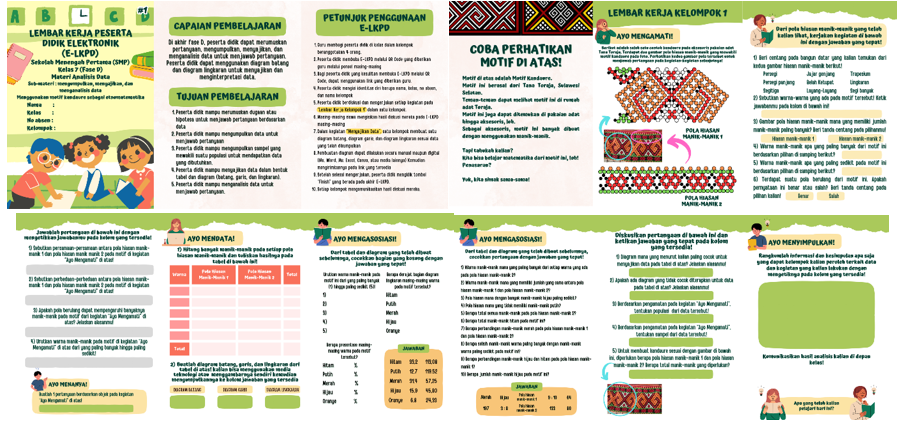
This study aims to develop learning tools based on ethnomathematics exploration through exploration of Tana Toraja kandaure motifs oriented to numeracy skills that are feasible and of high quality. The development model used in this research is the ADDIE development model. The sampling technique in this study used cluster sampling technique. The resulting product is an ethnomathematics-based learning device through exploration of Toraja kandaure motifs oriented to numeracy skills. The learning tools developed consist of teaching modules and online student worksheets. The research instrument consists of product validation sheets for material experts, media experts, and mathematics teachers, teacher product practicability questionnaires, student product practicability questionnaires, and learning implementation observation sheets, as well as pre-test and post-test. The analysis results showed that: Learning tools based on ethnomathematics exploration through exploration of Tana Toraja kandaure motifs oriented to numeracy skills developed have met the feasibility (validity) with an average validity score of 4.33 and interpretation of “Very Good”; (3) Learning tools developed have met the criteria of practicality with an average score of practicality questionnaires by students and teachers is 80.47%; (4) Learning tools improve students' numeracy skills with n-gain 0.48 and interpretation of “Medium”.
References
Akker, J. van den. (2010). Curriculum Design Research. In Introducing educational design research (pp. 37–52). SLO Netherlands institute for curriculum development.
Ascher, M., & D’Ambrosio, U. (1994). Ethnomathematics: A dialogue. For the Learning of Mathematics, 14(2), 36–43. https://flm-journal.org/Articles/6D5AE98E5864B7EE4924BFBFB3A8A.pdf
Asnawi, M. H., Annisa, H., Ulum, Moh. M., Arofah, N. L., & Hendrawati, N. E. (2022). Ethnomathematic Exploration At Agung Jami’ Malang Mosque In Improving Students’ Mathematic Problem Solving Ability. IndoMath: Indonesia Mathematics Education, 5(1), 13. https://doi.org/10.30738/indomath.v5i1.13
Branch, R. M. (2009). Instructional Design: The ADDIE Approach. Springer.
D’Ambrosio, U. (1985). Ethnomathematics and its place in the history and pedagogy of mathematics. For the Learning of Mathematics, 5(1), 44–48. https://www.jstor.org/stable/40247876
D’Ambrosio, U. (2007). The role of mathematics in educational systems. ZDM - International Journal on Mathematics Education, 39(1), 173–181. https://doi.org/10.1007/s11858-006-0012-1
Ernest, P. (1991). The Philosophy of Mathematics Education. The Flamer Press.
Grotlüschen, A., Desjardins, R., & Liu, H. (2020). Literacy and numeracy: Global and comparative perspectives. International Review of Education, 66(2–3), 127–137. https://doi.org/10.1007/s11159-020-09854-x
Gunay, K., & Takunyaci, M. (2023). Examining the Effect of Teaching with Ethnomathematics on Students’ Problem-Solving Skills on Transformation Geometry. Journal of Interdisciplinary Education: Theory and Practice, 5(2), 86–106. https://doi.org/10.47157/jietp.1384160
Gusfitri, W., Abdurrahman, A., Andrian, D., Nofriyandi, N., & Rezeki, S. (2022). Development of Mathematics Learning Tools Based on Ethnomathematics on Rectangular and Triangles in Junior High School. Prisma Sains : Jurnal Pengkajian Ilmu Dan Pembelajaran Matematika Dan IPA IKIP Mataram, 10(3), 609. https://doi.org/10.33394/j-ps.v10i3.5310
Husna, N., Saminan, & Abidin, Z. (2021). Development of student worksheets on ethnomathematics-based trigonometry through Project-Based Learning models. Journal of Physics: Conference Series, 1882(1). https://doi.org/10.1088/1742-6596/1882/1/012071
Molenda, M. (2003). In search of the elusive ADDIE model. Performance Improvement, 42(5), 34–36. https://doi.org/10.1002/pfi.4930420508
Munthahana, J., Budiarto, M. T., & Wintarti, A. (2023). The Application of Ethnomathematics in Numeracy Literacy Perspective: A Literature Review. Indonesian Journal of Science and Mathematics Education, 6(2), 177–191. https://doi.org/10.24042/ijsme.v6i2.17546
Nieveen, N. (1999). Prototyping to Reach Product Quality. In Design Approaches and Tools in Education and Training (pp. 125–135). Springer Netherlands. https://doi.org/10.1007/978-94-011-4255-7_10
Nieveen, N., & Folmer, E. (2013). Formative evaluation in educational design research. Design Research.
OECD. (2017). PISA 2015 Assessment and Analytical Framework. OECD Publishing.
OECD. (2022). PISA 2022: Mathematics Framework. https://pisa2022-maths.oecd.org/ca/index.html
OECD. (2023). PISA 2022 Results (Volume I and II) - Country Notes: Indonesia.
Opticia, N. N., Khabibah, S., & Masriyah, M. (2022). Development of guided inquiry model mathematics learning tools to practice critical thinking skills for students in linear program materials. International Journal of Trends in Mathematics Education Research, 5(2), 133–140. https://doi.org/10.33122/ijtmer.v5i2.95
Patmara, R., Wahyudin, A., & Susilaningsih, E. (2020). Implementation of Problem-Based Learning Model with Ethnomathematics Nuance Towards Students’ Problem-Solving Ability and Mathematics Anxiety. Journal of Primary Education, 9(2), 188–196. https://journal.unnes.ac.id/sju/index.php/jpe/article/view/31350
PIAAC. (2009). PIAAC Numeracy: A Conceptual Framework. In OECD Education Working Papers No.35 (35; OECD Education Working Papers, Vol. 35, Number 35). https://doi.org/10.1787/220337421165
Prahmana, R. C. I., & D’Ambrosio, U. (2020). Learning geometry and values from patterns: Ethnomathematics on the batik patterns of yogyakarta, indonesia. Journal on Mathematics Education, 11(3), 439–456. https://doi.org/10.22342/jme.11.3.12949.439-456
Rohaeti, E. E., Fitriani, N., & Akbar, P. (2020). Developing an Interactive Learning Model Using Visual Basic Applications With Ethnomathematical Contents To Improve Primary School Students’ Mathematical Reasoning. Infinity Journal, 9(2), 275. https://doi.org/10.22460/infinity.v9i2.p275-286
Rosa, M., Ambrosio, U. D., Clark, D., & Lawrence, O. (2016). Current and Future Perspectives of Ethnomathematics as a Program. Springer Nature.
Steen, L. A. (2001). Steen: Mathematics and Numeracy: Two Literacies. Journal of the Singapore Association of Mathematics Educators, 6(1), 10–16. https://www.statlit.org/pdf/2001-Steen-Mathematics-Educator-Singapore.pdf
Supriadi, S., Robiansyah, F., Wardana, D., Rahmanita, A., & Fatin, R. T. A. (2023). Sundanese ethnomathematics in fractional number learning with engklek games in pre service students: Didactical design findings. AIP Conference Proceedings, 2681(1). https://doi.org/10.1063/5.0122420
Suryawan, I. P. P., Jana, P., Pujawan, I. G. N., Hartawan, I. G. N. Y., & Putri, P. E. W. (2023). Ethnomathematically Controversial Problem-Based Multimodal Approach in Terms of Students ’ Critical Thinking Ability. Pegem Journal of Education and Instruction, 13(3), 323–336. https://doi.org/10.47750/pegegog.1
Downloads
Published
How to Cite
Issue
Section
License
Copyright (c) 2023 Instructional Media for Mathematics (IM Math)

This work is licensed under a Creative Commons Attribution-NonCommercial 4.0 International License.